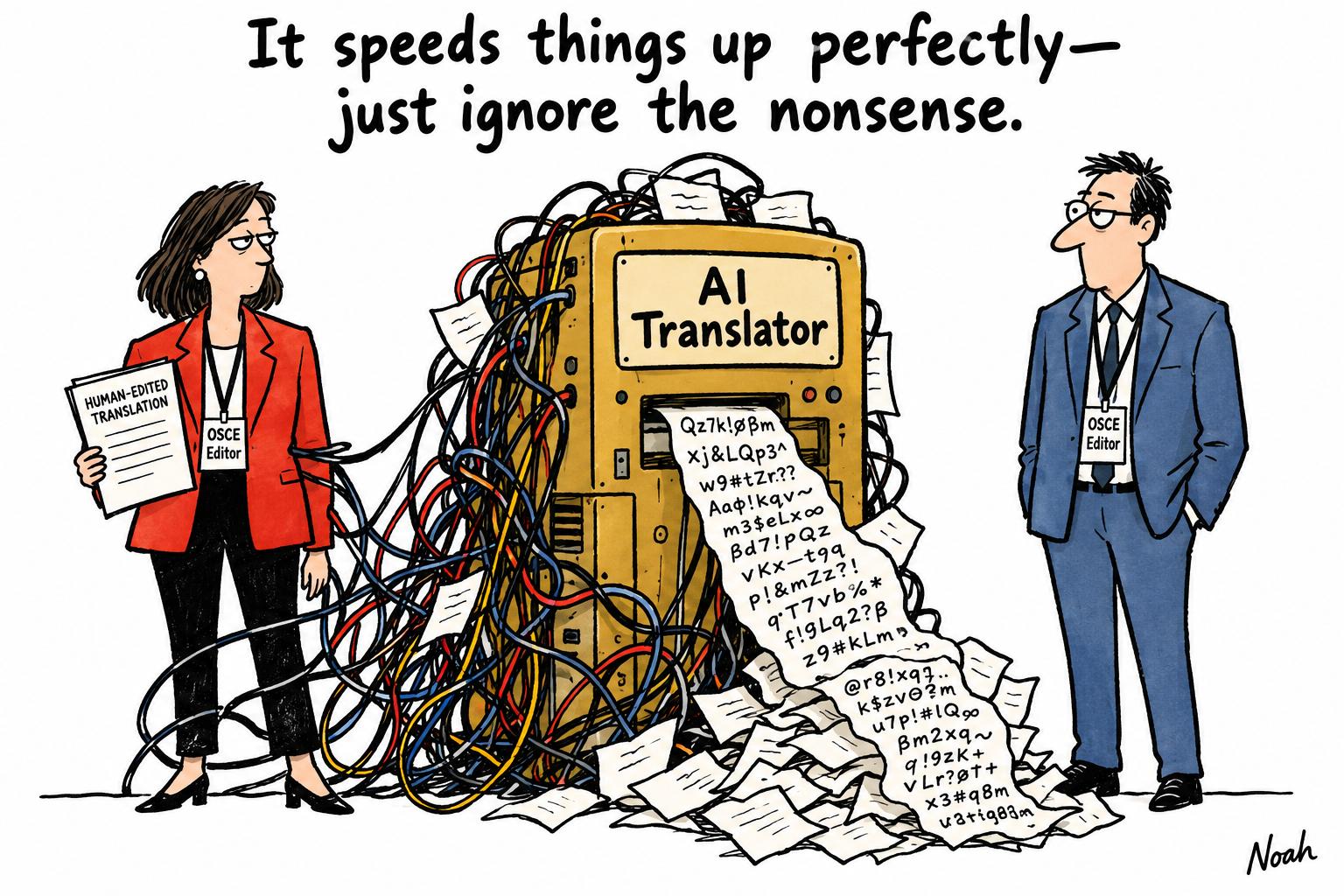
At a conference in Bishkek this month, editors and technology specialists from across Central Asia made a cautiously pragmatic case for artificial intelligence in the newsroom: useful for repetitive work, dangerous when treated as a substitute for judgement. The discussion formed part of the OSCE Central Asia Media Conference, which took place on 9-10 October and was framed by organisers around information integrity, media ethics and trust in the digital age.
The panel brought together Azat Seyitmuhammedov of Turkmenistan’s Arzuw News, Dina Maslova of Kyrgyzstan’s Kaktus Media, the Tajik digital rights specialist Khurshed Qurbonshoev, and the Kazakh lecturer Askhat Yerkimbay. Their examples suggested that AI is already embedded in regional editorial workflows, but in narrowly defined ways: translation, transcription, monitoring and content digestion, rather than final editorial decision-making.
Seyitmuhammedov described how a small four-person team uses a language-model plugin to process a large archive and turn fresh material from selected outlets and government sites into short summaries delivered to editors through Telegram. The system is designed to speed up the first pass, not to replace editorial scrutiny. According to his account, human checks remain essential for names, figures and factual detail, especially before English-language publication. The same principle applies to Kaktus Media, where Maslova said AI is helpful for transcribing interviews and, in some cases, translating between Russian and Kyrgyz, but still requires substantial human correction.
Maslova also drew a line between convenient automation and editorial risk. She said her newsroom uses AI sparingly for voiceovers and image generation because mistakes in place names, statistics or visual framing can quickly undermine credibility. Professional video editors still handle more complex work, while experiments with chatbots for advertising and accounting were not especially successful. Even where tools such as Gemini and Claude are used to compress long reads into social media formats, every headline and caption is checked by editors before publication.
Yerkimbay argued that the apparent efficiency gains of AI can be deceptive. In his view, journalists often spend extra time validating machine output, producing what he called an efficiency trap: work that looks faster on paper but still demands human oversight. He also pointed to the unequal performance of language models across the region’s languages, warning that low-resource languages remain more vulnerable to error than English or Russian. That imbalance, he suggested, risks deepening the digital divide unless newsrooms understand the limitations of the systems they adopt.
The panel’s broader message was not anti-technology, but anti-complacency. AI, the speakers said, should be reserved for routine and mechanical tasks so reporters can spend more time on reporting, interviewing and verification. Qurbonshoev stressed that audiences will continue to value distinctive human voice and reporting with genuine local texture, even as synthetic content becomes more common. Seyitmuhammedov was the most outspoken about structural change, predicting that some desk-based roles may disappear as automation improves. Yet he, too, drew a clear distinction between replaceable production work and original coverage in the field, which he said will still depend on reporters and camera crews. The consensus in Bishkek was that no newsroom can afford a simple yes-or-no policy on AI; each outlet must decide what can be automated, what must be checked and who remains answerable for the final product.
Source Reference Map
Inspired by headline at: [1]
Sources by paragraph:
- Paragraph 1: [2], [3], [5]
- Paragraph 2: [1], [2], [7]
- Paragraph 3: [1]
- Paragraph 4: [1]
- Paragraph 5: [1], [3]
- Paragraph 6: [1], [2], [3]
Source: Noah Wire Services