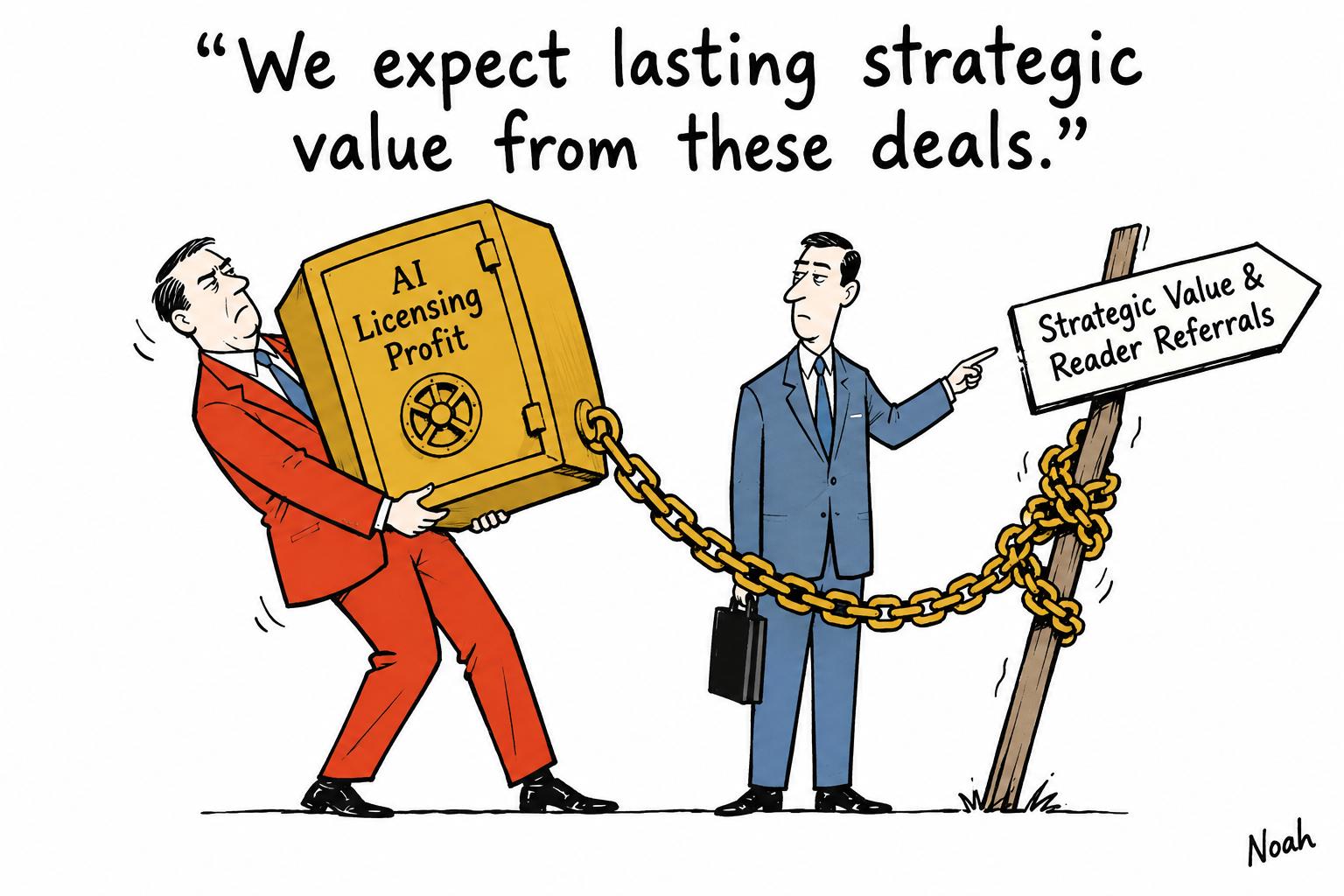
The New York Times says AI licensing deals must offer lasting strategic value, reader referrals and firm controls over how its journalism is used.
The New York Times is approaching artificial intelligence licensing with caution, insisting that any deal must do more than simply deliver a cheque. Speaking at the Digiday Publishing Summit in Miami last week, Adam Greenberg, the paper’s vice-president of strategic partnerships, said the market for AI licensing has improved for publishers, but remains immature and difficult to navigate. He argued that while AI companies are increasingly expected to pay for content or at least allow publishers to opt out, the surrounding marketplace is still far from settled.
Greenberg said the central challenge is that publishers cannot yet know how their material will be used over time, or what the dominant AI products will look like in a few years. That uncertainty makes it hard to price rights fairly, define how content may be reused and decide who should control outputs created from licensed material. Industry commentary from ContentDividend and Talkory has made similar points, noting that publishers entering AI agreements need clarity on training, retrieval and display rights, attribution, revenue share, duration and audit provisions if they are to avoid disputes later on.
For the Times, Greenberg said, any agreement must satisfy three tests: clear value, a durable relationship and firm controls over how material is used. He rejected the idea of one-off payments with no wider strategic benefit, arguing that a licensing arrangement should also support collaboration, ecosystem development and, ideally, stronger referral or attribution links that send readers back to the publisher’s own platforms. That matters because the Times remains, above all, a subscription business built on direct audience relationships and habitual readership.
Greenberg said the company’s partnership with Amazon fits those requirements because it combines compensation, collaboration and safeguards that leave the publisher comfortable with the arrangement. He declined to discuss whether other AI licensing deals are in place, but suggested the small number of public transactions reflects how demanding these negotiations are. Even as AI labs and platforms increasingly speak the language of sustainability, copyright respect and creator revenue, he said, the practical details remain the hardest part.
Source Reference Map
Inspired by headline at: [1]
Sources by paragraph:
Source: Noah Wire Services
Noah Fact Check Pro
The draft above was created using the information available at the time the story first
emerged. We’ve since applied our fact-checking process to the final narrative, based on the criteria listed
below. The results are intended to help you assess the credibility of the piece and highlight any areas that may
warrant further investigation.
Freshness check
Score:
8
Notes:
The article was published on September 23, 2026, which is within the past 7 days, indicating high freshness. However, the content is based on statements made by Adam Greenberg at the Digiday Publishing Summit in Miami, which took place in September 2026. This suggests that the article is reporting on recent events, but the information may have been disseminated through other channels before this publication. ([digiday.com](https://digiday.com/media/digiday-publishing-summit-september-2026-recap-how-publishers-are-rebuilding-for-the-post-search-era/?utm_source=openai))
Quotes check
Score:
7
Notes:
The article includes direct quotes from Adam Greenberg, VP of Strategic Partnerships at The New York Times. While these quotes are attributed to Greenberg, they are not independently verifiable through other sources. This raises concerns about the originality and verification of the quotes. ([digiday.com](https://digiday.com/media/digiday-publishing-summit-september-2026-recap-how-publishers-are-rebuilding-for-the-post-search-era/?utm_source=openai))
Source reliability
Score:
6
Notes:
The article is published by Digiday, a reputable media company known for its coverage of the publishing industry. However, the content is based on statements made at the Digiday Publishing Summit, which may have been reported elsewhere. Additionally, the article references other sources, such as ContentDividend and Talkory, but these are not major news organisations, which may affect the overall reliability of the information. ([digiday.com](https://digiday.com/media/digiday-publishing-summit-september-2026-recap-how-publishers-are-rebuilding-for-the-post-search-era/?utm_source=openai))
Plausibility check
Score:
8
Notes:
The claims made in the article align with known industry trends regarding AI licensing and publisher partnerships. However, the lack of independent verification and the reliance on a single source for direct quotes reduce the overall confidence in the accuracy of the information. ([digiday.com](https://digiday.com/media/digiday-publishing-summit-september-2026-recap-how-publishers-are-rebuilding-for-the-post-search-era/?utm_source=openai))
Overall assessment
Verdict (FAIL, OPEN, PASS): REVIEW
Confidence (LOW, MEDIUM, HIGH): MEDIUM
Summary:
The article provides a timely overview of The New York Times' approach to AI licensing partnerships, based on statements made by Adam Greenberg at the Digiday Publishing Summit. However, the reliance on a single source for direct quotes and the lack of independent verification raise concerns about the accuracy and reliability of the information. Further verification from independent sources is recommended before publishing.