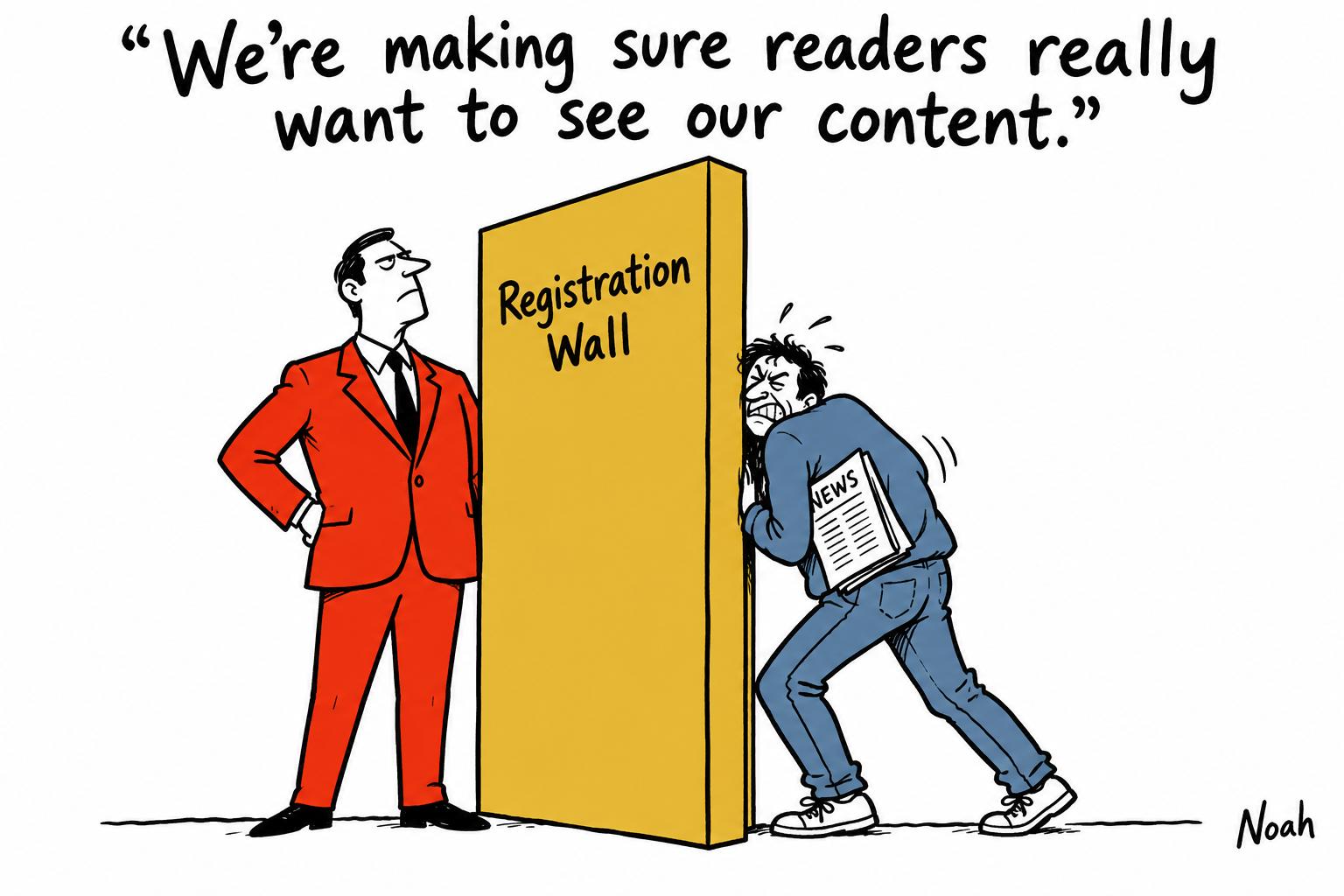
As AI-driven search tools and shrinking referral traffic make audiences less predictable, publishers are revisiting one of digital media’s oldest tactics: the registration wall. The thinking is straightforward. If fewer readers are arriving from search or social, the ones who do reach a publisher’s site may be worth more if they can be identified, profiled and brought into a direct relationship rather than allowed to remain anonymous. Digiday reported that this shift is prompting editors and commercial teams to rethink where friction belongs in the user journey, and when it is worth asking a casual reader to identify themselves.
The Verge is among those testing the idea. Esther Cohen, the publisher’s director of audience and subscriptions, told Digiday that the company plans to introduce a hard registration wall to a group of readers later this month in order to see whether high-traffic but low-converting audiences can be converted into known users. She said the publisher is considering different forms of gating, including applying registration only to certain referral sources or to a proportion of visitors, and argued that the goal is to move readers further down the funnel, even if they are not ready to subscribe. Cohen said the trade-off may be worthwhile if a smaller audience is of higher quality.
For publishers, the commercial appeal is not limited to subscriptions. According to publishing executives quoted by Digiday, registration data can improve first-party targeting, strengthen audience segmentation and lift programmatic rates because advertisers are willing to pay more for known users than for anonymous traffic. One executive said rates on registered audiences could be dramatically higher than on drive-by visitors, while another described registration data as useful both for identifying potential subscribers and for charging more for newsletter readers. Related industry analysis from registration-tech vendors says that a clear value exchange, short forms and easy social sign-in options can materially improve conversion, while organic search visitors tend to register at much lower rates than direct or returning users.
Even so, the strategy is far from a guaranteed answer to traffic losses. Digiday reported that one food publisher saw disappointing take-up when it introduced a registration wall, only to find that a later subscription launch, bundled with print and expanded recipe access, produced much stronger demand. Another publisher said a simple shift towards exclusive framing in headlines has helped drive a double-digit increase in subscription conversions. But the same reporting also made clear that many local and niche publishers still struggle to make the maths work: subscription revenue may grow, yet still fail to replace what is lost when audience volume falls. In some cases, the more pragmatic outcome is to use registrations to build richer audience profiles and sell more valuable newsletter and sponsorship packages, rather than to force a paywall into places where it would reduce overall revenue.
The broader backdrop helps explain why this debate is intensifying now. Digiday also noted that Google has begun showing some publishers how many users have selected them as a preferred source, while Apple is preparing additional privacy restrictions that could further squeeze the programmatic advertising ecosystem. At the same time, publishers are being pressed by AI search summaries that answer more queries without sending users on to the original source. Against that backdrop, Joy Robins, The New York Times’ global chief advertising officer, told Digiday at Advertising Week New York that direct consumer relationships are becoming more valuable, both because trust matters more and because publishers such as the Times can offer advertisers a rare and recognisable environment. She said the company is continuing to improve targeting and measurement, including through its BrandMatch contextual tool, while remaining cautious about agentic media buying. In that sense, registration walls are not just a defensive move; they are becoming part of a wider effort to make owned audiences more measurable, more monetisable and less dependent on the whims of platform traffic.
Source Reference Map
Inspired by headline at: [1]
Sources by paragraph:
- Paragraph 1: [2], [5]
- Paragraph 2: [1], [4]
- Paragraph 3: [1], [3], [4]
- Paragraph 4: [1], [2], [5], [6]
- Paragraph 5: [1]
Source: Noah Wire Services