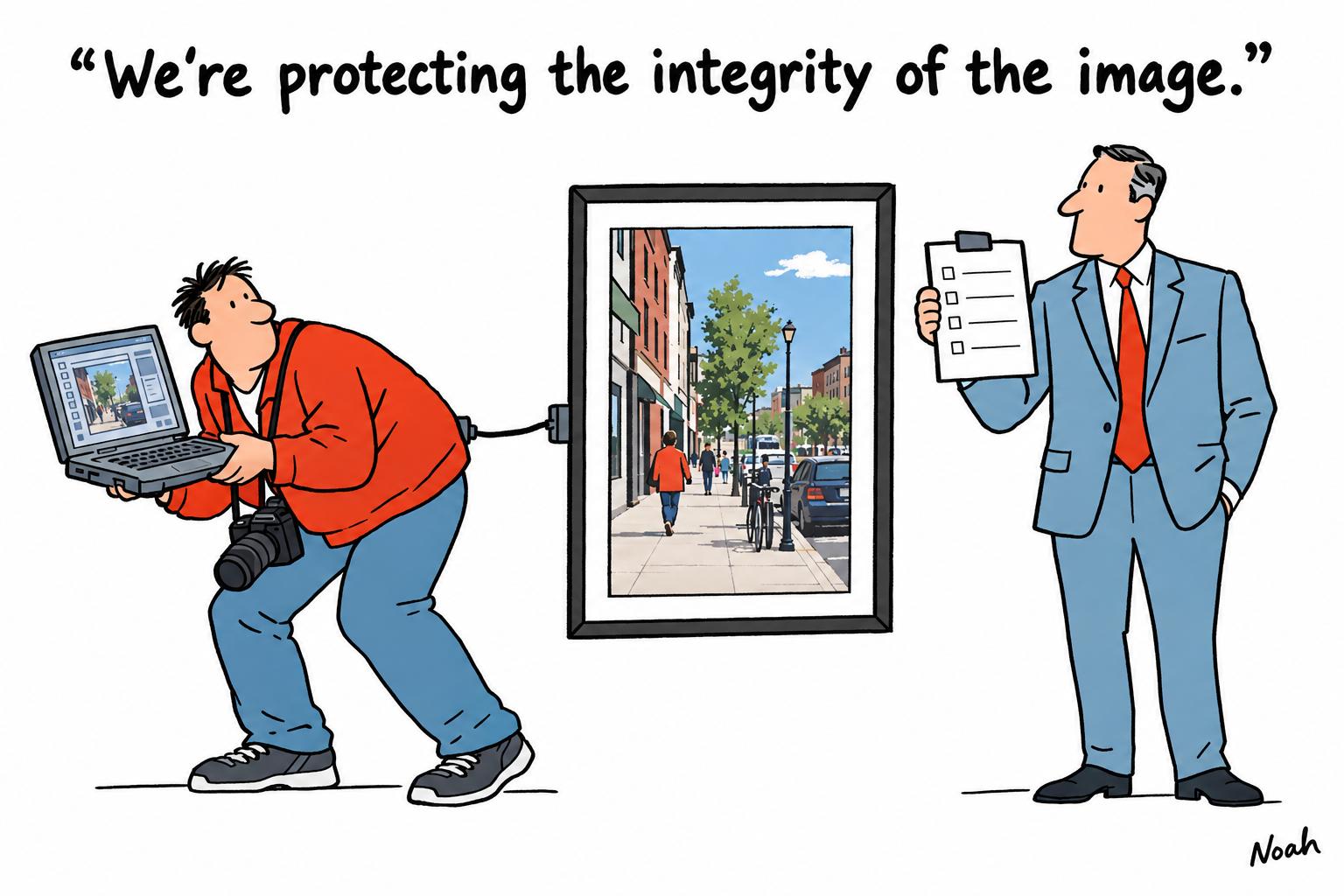
The New York Times has told freelance photographers working on its assignments to avoid Photoshop 2027, citing the risk that generative artificial intelligence tools could be used without their knowledge. The instruction covers version 28.0.0 and later, but does not prohibit Photoshop altogether: earlier releases remain acceptable.
The concern, reported by The Verge, is that some features in the latest version may involve generative AI without making that intervention clear to the person editing the image. The newspaper’s photography leaders, Meaghan Looram and Josh Haner, warned contributors that such use could also cause an image’s metadata to identify it as AI-edited. For a newsroom that depends on photographs as evidence of real events, uncertainty about how an image was processed creates both editorial and reputational risks.
The Times’ ethical-journalism standards prioritise accuracy and warn against changes that could mislead readers about what happened. As PetaPixel reports, the paper’s rules bar contributors from adding or removing elements and restrict adjustments that might change an image’s meaning. Ordinary corrections intended to reproduce a scene faithfully are not the same as altering its contents; the difficulty is ensuring that distinction remains clear when generative tools are integrated into familiar editing software.
That distinction matters even though image provenance systems are intended to strengthen trust. Adobe’s Content Credentials can record information about an asset’s creator and production history, including whether AI was used. The company describes them as a way to help audiences understand how digital content was made. But such records document an image’s history; they do not, by themselves, prove that it accurately depicts an event.
Adobe’s guidance also indicates that some credentials may persist beyond the initial edit. Generative-AI disclosures cannot be deleted, while removing a credential from Adobe’s cloud does not necessarily remove information embedded in a file or already published elsewhere. For photographers delivering work to a news organisation, that makes it important to know not only what an editing tool has done, but what information may travel with the image.
The immediate response is a targeted precaution, not a wholesale rejection of digital editing. Contributors can keep using older versions of Photoshop, and the restriction applies to work for the Times rather than to every use of the software. Yet relying on users to avoid a particular release may be inconvenient, especially when Creative Cloud encourages customers to keep their applications up to date.
Creative Bloq argues that a clear, comprehensive control to disable generative AI could address the underlying uncertainty. It points to Canva and Maxon as companies that have introduced ways to switch off generative features, including options that may suit workplaces seeking consistent settings across their teams. The proposal recognises that customers’ needs differ: some welcome AI tools, while documentary photographers may prefer a workflow in which those functions cannot be activated accidentally.
The dispute highlights a challenge for software makers as generative capabilities become embedded in established creative products. Adobe’s provenance tools are designed to make image histories more transparent, but the Times’ instruction shows that transparency alone may not resolve concerns if users cannot readily tell when a tool has crossed from technical correction into generated alteration. For photojournalists, confidence in the editing process may matter more than access to the newest features.
Source Reference Map
Inspired by headline at: [1]
Sources by paragraph:
- Paragraph 1: [2], [3]
- Paragraph 2: [2], [3]
- Paragraph 3: [3], [4]
- Paragraph 4: [5]
- Paragraph 5: [6]
- Paragraph 6: [2], [3]
- Paragraph 7: [7]
- Paragraph 8: [4], [5]
Source: Noah Wire Services