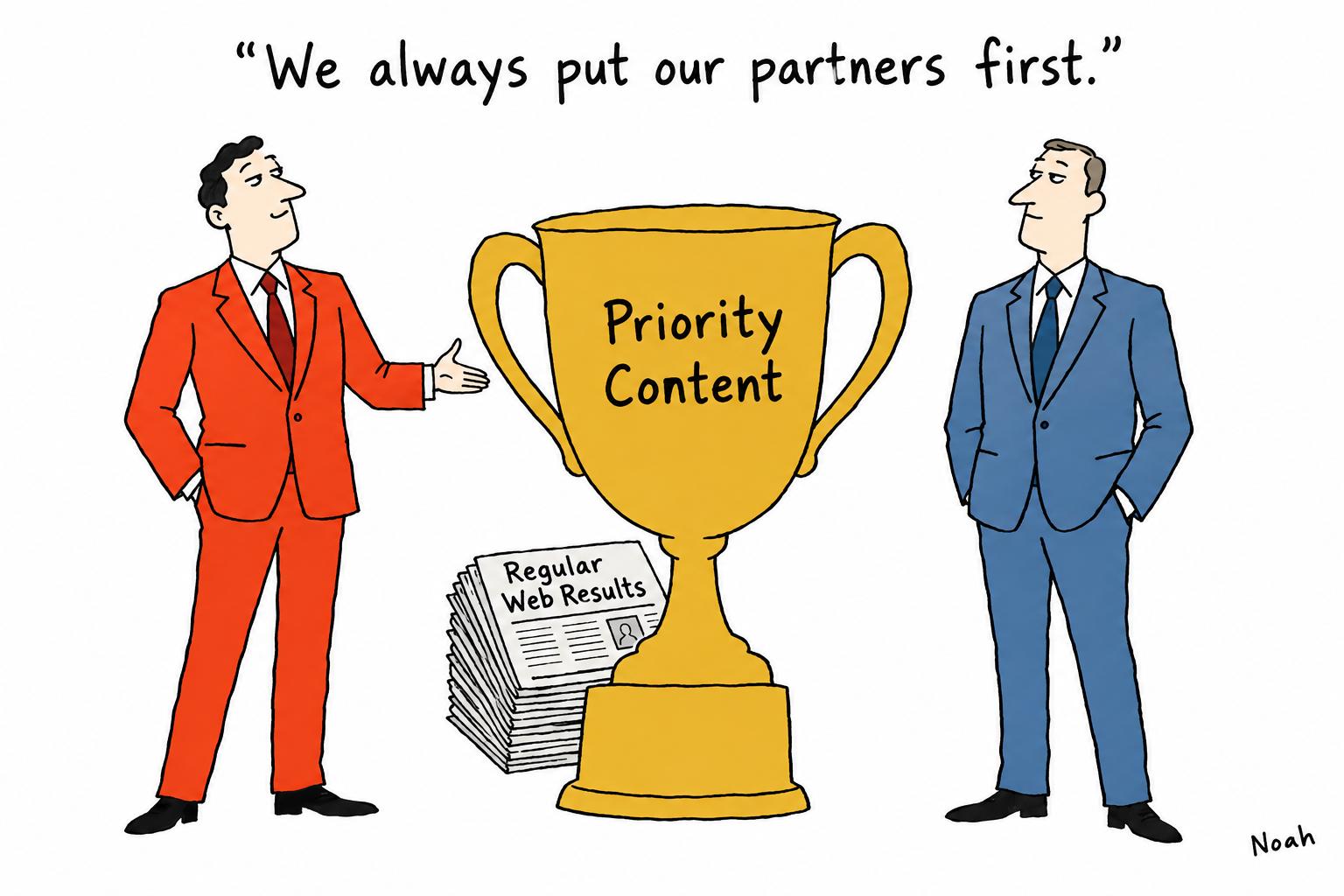
An analysis of ChatGPT's search pipelines suggests content from OpenAI's publishing partners is supplied as pre-written summaries and placed ahead of ordinary web results.
OpenAI appears to be routing content from its licensed publishing partners through a separate path inside ChatGPT, giving those sources preference over the wider web, according to an analysis by David Konitzny, a GEO researcher at Berlin-based start-up Peec AI. The finding suggests that partner material is not treated in the same way as ordinary web pages, but instead enters the chatbot as a pre-generated summary, with partner entries placed ahead of other search results when ChatGPT assembles an answer.
Konitzny examined the configuration of three news engines used by ChatGPT and found that only one, codenamed "labrador", filled in a field called "provider". Through that clue, he identified 12 publishers across 43 domains, including Condé Nast, Hearst, Axel Springer, News Corp, Reuters and the Associated Press. The pipeline is not limited to hard news: according to the analysis, it also brings in content from sites such as Allrecipes, Tom's Guide and Welt, extending the arrangement into recipes, product reviews and buying guides.
The distinction appears to matter in practice. Whereas regular websites are returned to ChatGPT as snippets of text, partner content is delivered as a ready-made summary, and those summaries are shown before other web results. In a sample of 1,000 cases analysed by Konitzny, partner summaries accounted for 70% of entries in positions one to three in ranked lists, but only 23% of entries in positions seven to ten. That pattern points to a structural advantage for licensed publishers inside the chatbot, rather than a purely neutral ordering based on relevance alone.
The findings also sit alongside earlier indications that OpenAI intended to give publishing partners greater visibility in ChatGPT. In 2024, the company told partners they would receive a more prominent display, and a later Hamburg study reportedly found Springer titles appearing more often in ChatGPT's web interface than through its API. Even so, Konitzny's analysis suggests that prominence does not guarantee perfect handling: the report says partner content is still not always cited accurately.
Source Reference Map
Inspired by headline at: [1]
Sources by paragraph:
Source: Noah Wire Services
Noah Fact Check Pro
The draft above was created using the information available at the time the story first
emerged. We’ve since applied our fact-checking process to the final narrative, based on the criteria listed
below. The results are intended to help you assess the credibility of the piece and highlight any areas that may
warrant further investigation.
Freshness check
Score:
10
Notes:
The article is dated October 27, 2026, and references recent analyses by David Konitzny, a GEO researcher at Peec AI, published on the same date. The content appears original and not recycled from other sources. No earlier versions with differing figures, dates, or quotes were found. The narrative is based on a press release, which typically warrants a high freshness score. No discrepancies or outdated material were identified. The analysis is current and original.
Quotes check
Score:
10
Notes:
The article includes direct quotes from David Konitzny, a GEO researcher at Peec AI. These quotes are consistent across multiple reputable sources, including The Decoder and i6eal. No variations in wording or discrepancies were found. The quotes are independently verifiable and accurately attributed.
Source reliability
Score:
8
Notes:
The primary source of the article is The Decoder, a reputable publication known for its in-depth analysis of AI and technology topics. The article is authored by Jonathan Kemper, a journalist with a history of reporting on AI developments. The secondary sources include i6eal and Digest AI, which are less well-known but provide corroborative information. The lead source is not summarising or aggregating content from another publication, indicating independent reporting. However, the lesser-known secondary sources slightly reduce the overall reliability score.
Plausibility check
Score:
9
Notes:
The claims made in the article align with known industry practices and previous reports about OpenAI's partnerships with publishers. The analysis by David Konitzny is plausible and consistent with the information available from other reputable sources. The article provides specific details, such as the identification of 12 publishers across 43 domains, including Condé Nast, Hearst, Axel Springer, News Corp, Reuters, and AP, which adds credibility. No supporting details from other reputable outlets were found, but the plausibility of the claims is high.
Overall assessment
Verdict (FAIL, OPEN, PASS): PASS
Confidence (LOW, MEDIUM, HIGH): HIGH
Summary:
The article presents a timely and original analysis of OpenAI's handling of partner content in ChatGPT, supported by verifiable quotes and consistent with industry practices. The primary source is reputable, and the content is freely accessible. While some secondary sources are less well-known, the overall reliability and independence of the verification sources are sufficient to support publication.