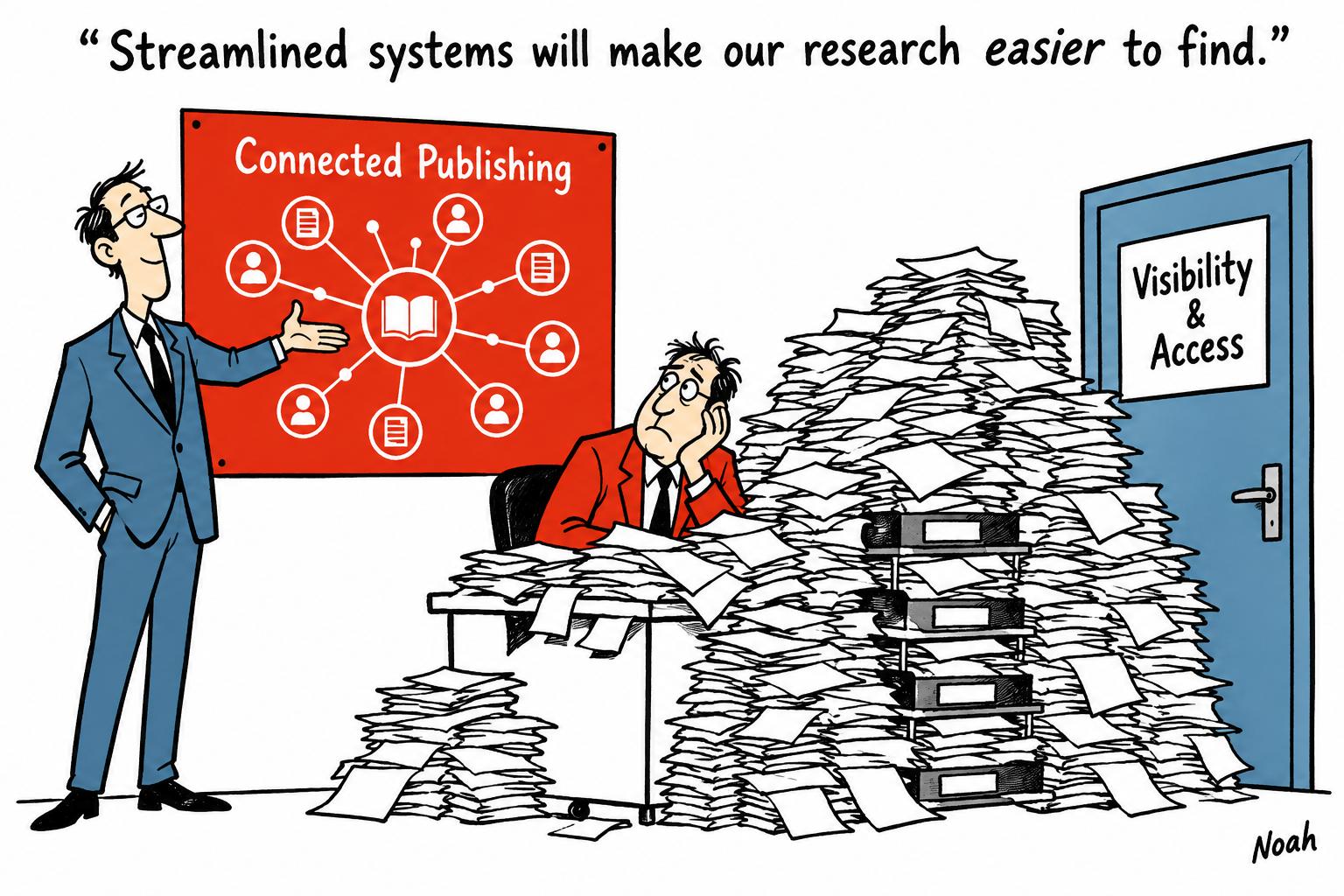
Digital transformation has become a familiar phrase in scholarly publishing, but the technology itself is not what changes research impact. The real shift comes when publishers move from isolated systems to a connected environment that brings manuscript submission, peer review, production and distribution into one workflow. According to Sabinet’s account of its Online Publishing model, that kind of integration can reduce duplication, ease administrative pressure and allow editorial teams to spend more time on quality rather than on managing disconnected processes.
The case for connected publishing is stronger because publication alone no longer guarantees visibility. Research now has to be discoverable across search engines, repositories and indexing services, and that depends on more than a final PDF. Industry practice increasingly expects journals and books to be released in multiple digital formats, backed by structured metadata and interoperable production standards. Sabinet argues that PDF, full-text XML and EPUB each serve a distinct purpose: the first supports formal distribution, the second improves machine readability and indexing, and the third expands access across devices.
Structured metadata sits at the centre of that system. Rather than functioning as an afterthought, it determines whether content can be accurately indexed, linked and retrieved across scholarly platforms. That is why discoverability is increasingly treated as a publishing outcome in its own right, not a separate marketing task. The broader trend is visible in other African digital knowledge initiatives as well: the African Digital Humanities Lab combines events, editorial publishing and community writing on a single platform; Itanile offers a digital publishing route for African authors; and the Buntu Foundation is building pathways to support African researchers and AI talent. Each reflects the same underlying logic: access, infrastructure and visibility matter as much as the content itself.
For African scholarship, that logic has particular weight. Many publishers still operate with limited resources and fragmented systems, which can make it harder to maintain consistency, preserve quality and extend reach beyond local networks. Sabinet says its approach is designed to address precisely those pressures by combining automation, publishing support and recognised standards within an ecosystem tailored to African publishers. The aim is not to displace editorial judgement, but to give editors and institutions the tools to move research more efficiently from submission to discovery.
Taken together, these developments point to a broader shift in scholarly communication. Publishing research is only the beginning; the greater challenge is ensuring it remains usable, accessible and visible over time. In that sense, connected publishing is less a technical upgrade than an infrastructure decision. It determines whether African research remains trapped in administrative bottlenecks or is equipped to travel, be found and contribute fully to the global conversation.
Source Reference Map
Inspired by headline at: [1]
Sources by paragraph:
- Paragraph 1: [2], [5]
- Paragraph 2: [1], [5]
- Paragraph 3: [2], [3], [4], [5]
- Paragraph 4: [1], [5]
- Paragraph 5: [1], [2], [4], [5]
Source: Noah Wire Services