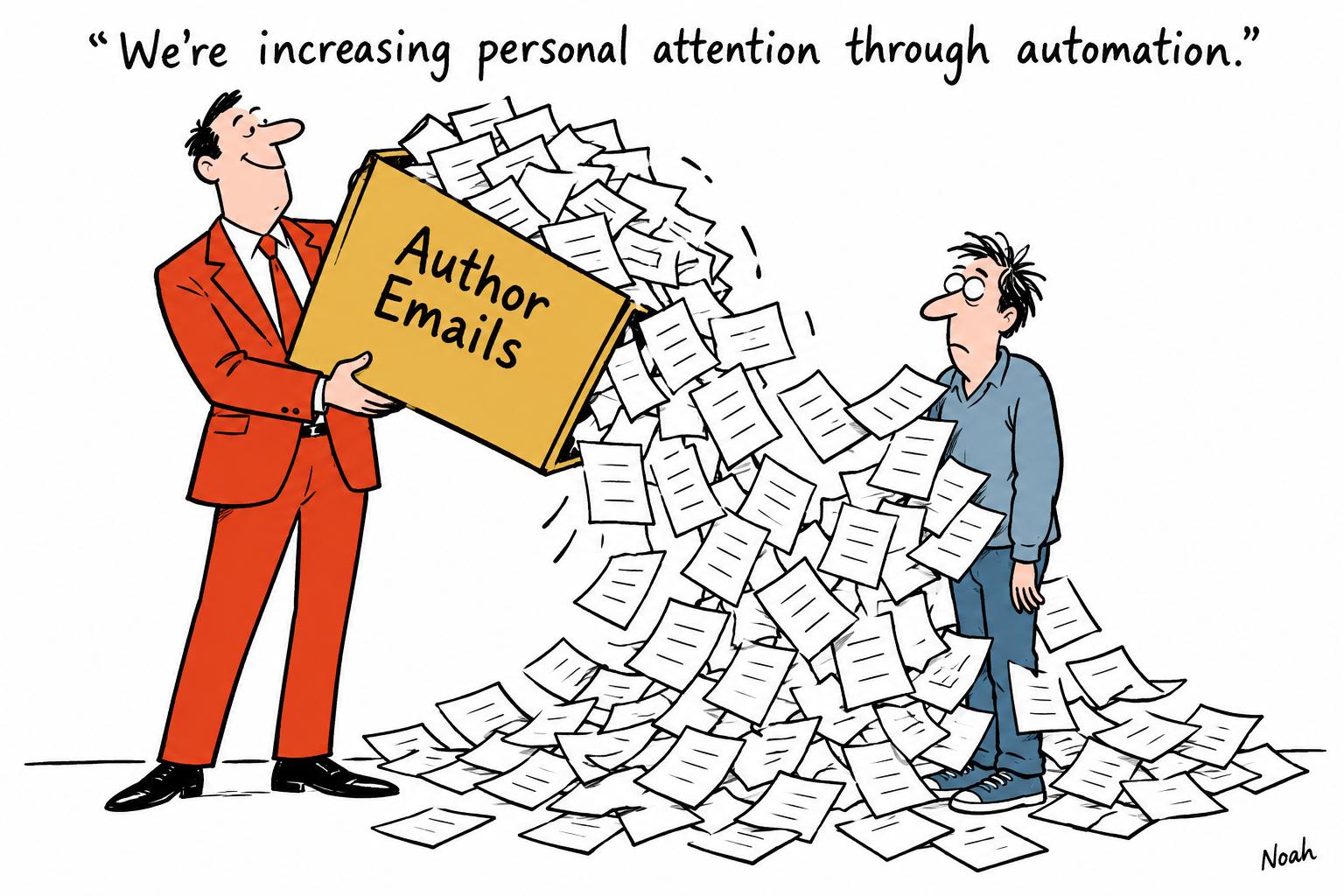
A recent wave of unease in book publishing is not just about artificial intelligence itself, but about how and why it is being introduced. According to WIRED, at least three of the Big Five US publishers, HarperCollins, Simon & Schuster and Hachette, have begun using generative AI tools in publicity, marketing and other internal tasks, including draft emails to literary agents, back-cover copy, cover art and promotional material. The reporting suggests that much of this activity has taken place without public disclosure or author consent, sharpening anxieties among staff about transparency and the direction of the industry.
The unease is easy to understand in an environment already defined by overload. One book reviewer described receiving dozens of publisher emails in a single week, representing far more titles than any one person could reasonably cover. That flood of pitches is not an isolated irritation but a symptom of a wider problem in publishing: too many books, too little time and too little capacity to make every title stand out. For publicists, the work is increasingly about trying to secure attention in a market where attention itself is scarce.
That pressure helps explain why some senior executives appear drawn to automation. But, as WIRED and related coverage have shown, the move towards AI has often been driven from the top, with staff then left to work out where the tools might actually be useful. The result, according to employees quoted in the reporting, is not just experimentation but a shift towards using large language models for routine communications and promotional tasks. Critics inside and outside the industry worry that this approach encourages de-skilling, while also distancing workers from the craft and judgement that publishing has traditionally relied upon.
There is also a deeper contradiction at work. Several of the same publishers accused of quietly using AI inside their businesses have publicly pushed back against the use of AI in authors’ work, including in disputes over training data and generated content. Entangled Text, Sandbox Desk and other outlets have highlighted that tension, portraying a sector that wants to preserve control over its own intellectual property while adopting the same technology internally. That contrast has made the issue especially politically fraught for authors and employees alike.
Yet the strongest criticism is not simply that publishers are using AI, but that they may be using it badly. In the view of the reviewer, the problem is not whether technology can help sort large volumes of information; it is whether it is being used to amplify noise instead of improving relevance. Automating publicity outreach at scale, he argues, is likely to swamp inboxes further, not reduce the burden. If every title is blasted out by machine, the effect may be to make the human recipients more likely to ignore everything.
The alternative, he suggests, is not replacement but curation. A machine might be genuinely useful as a classifier, helping to match a reviewer’s known interests with the right books and filter out the many pitches that will never be relevant. That would require a far more careful, personalised and restrained use of AI than the one now being described in the trade press. It would also mean seeing technology as a tool for better judgement, rather than simply a way to produce more content more cheaply.
For all the scepticism about automation, the piece leaves room for a more constructive possibility: that major publishers could use AI to support better human relationships instead of replacing them. The reviewer argues that the most effective pitches come from people who know him, however lightly, and who have paid attention to what he reads and reviews. In that sense, the real lesson of the current AI debate may be less about efficiency than about trust. Publishing, the article suggests, still depends on attention, discretion and care, and those are qualities no algorithm can supply on its own.
Source Reference Map
Inspired by headline at: [1]
Sources by paragraph:
- Paragraph 1: [2], [3], [4]
- Paragraph 2: [1]
- Paragraph 3: [2], [5], [6]
- Paragraph 4: [3], [4], [5]
- Paragraph 5: [1]
- Paragraph 6: [1]
- Paragraph 7: [1], [3], [4]
Source: Noah Wire Services