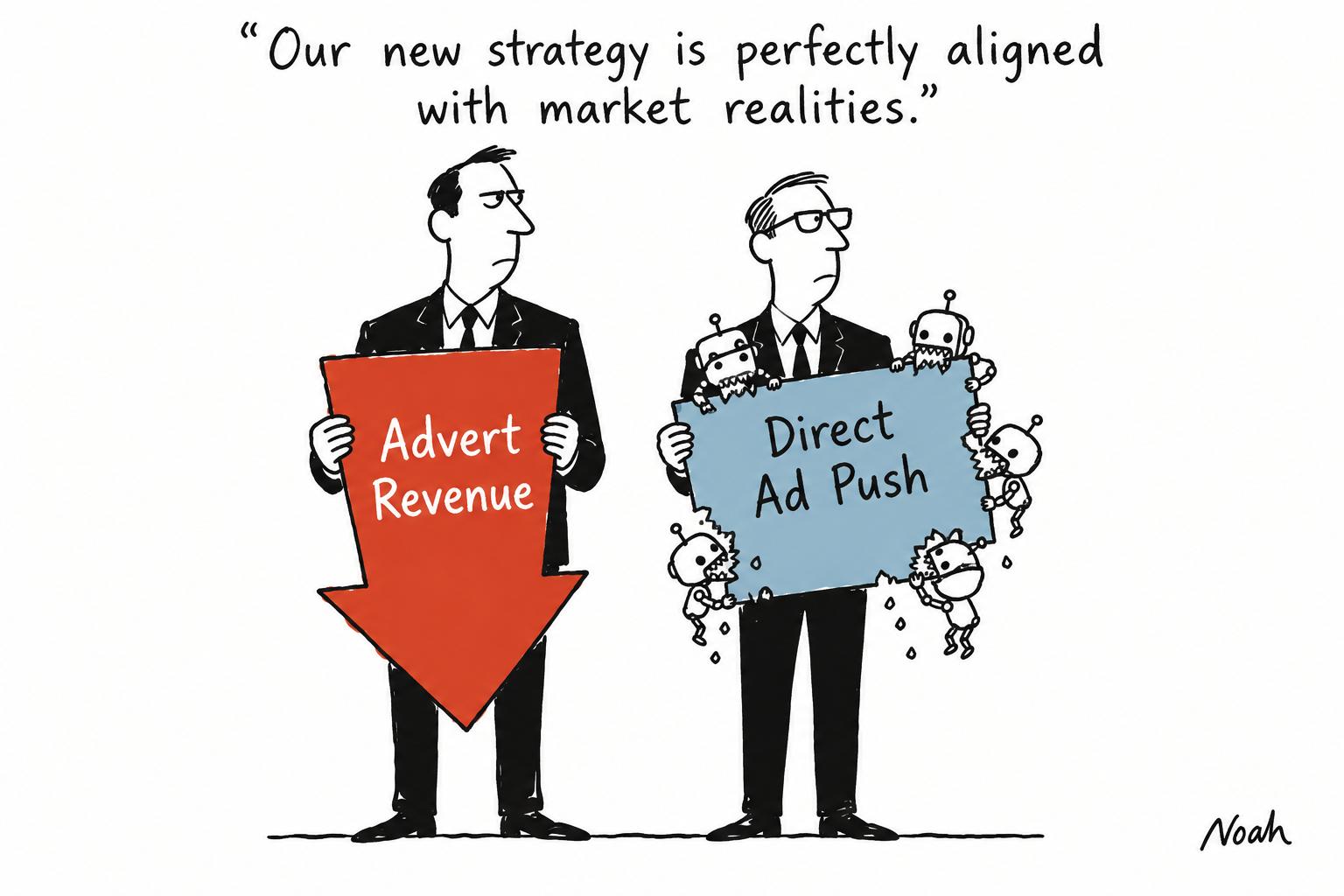
Broker downgrades and sharply lower price targets have revived doubts over whether Future’s shift towards direct advertising can offset falling traffic, weaker programmatic income and AI-driven disruption.
Future plc remains under investor scrutiny after a series of broker downgrades and sharply lower price targets renewed doubts over whether the group’s shift towards direct advertising can offset broader weakness in digital publishing. According to recent market commentary, the stock has been hit by concerns about search-engine changes, AI-driven traffic disruption and the growing fragility of publishers that depend on programmatic advertising and affiliate revenue.
The latest blow came in May, when Stifel cut its rating on Future to "hold" from "buy" and reduced its price target by 64%, sending the shares sharply lower. The broker said the publisher was struggling to adapt to a channel-agnostic model and pointed to declining revenues as well as heavier exposure to Google Discover. It also lowered revenue and earnings estimates for the 2026 and 2027 financial years. Earlier, Jefferies had taken a similarly cautious view, downgrading the group in March and slashing its target price while warning that artificial intelligence and changing media consumption habits could weigh on both growth and margins.
Future’s own recent updates, however, show a business trying to counter those pressures with a deliberate change in emphasis. In a trading statement published in February 2026, the company said performance over the first four months of the year was broadly in line with expectations and that it remained on track to meet full-year forecasts, with results expected to be weighted towards the second half. The company said direct digital advertising in the UK and US was improving, while programmematic advertising and e-commerce were still under strain, and magazine revenues remained comparatively resilient.
That narrative builds on the prior year’s results, when Future reported revenue of £391.5 million for 2024, down 3% year on year. The group said the fall reflected a modest organic decline and adverse foreign-exchange movements, although it returned to organic growth in the second quarter. UK revenue rose 3% on an organic basis, helped by strong growth at Go.Compare and a solid contribution from B2B, while other media activities, including digital advertising, affiliate products and events, were hurt by market conditions. In its 2025 full-year results, Future said direct advertising had grown in the second half in both the US and the UK, even as programmatic income and e-commerce remained pressured and sessions fell.
For management, the central case remains that a broad portfolio of specialist brands offers a degree of resilience in a volatile market. Future has argued that its mix across technology, lifestyle and other verticals reduces dependence on any single title or audience segment, and that direct relationships with advertisers should prove more durable than commoditised ad inventory sold through third parties. Investors, though, appear unconvinced that those efforts can yet fully neutralise the structural headwinds facing digital publishers. For now, Future stands as a live test of whether scale, brand diversity and direct monetisation can overcome the effects of a fast-changing discovery ecosystem.
Source Reference Map
Inspired by headline at: [1]
Sources by paragraph:
Source: Noah Wire Services
Noah Fact Check Pro
The draft above was created using the information available at the time the story first
emerged. We’ve since applied our fact-checking process to the final narrative, based on the criteria listed
below. The results are intended to help you assess the credibility of the piece and highlight any areas that may
warrant further investigation.
Freshness check
Score:
7
Notes:
The article was published on September 22, 2026, which is within the past month, indicating recent content. However, the narrative heavily relies on information from May and March 2026, including analyst downgrades and company statements. This suggests that the article may be recycling older material, which could affect its freshness. Additionally, the article is sourced from Kalkine Media, a financial news platform that often aggregates content from other sources, raising concerns about originality. The reliance on older data and potential content aggregation practices warrant a reduced freshness score.
Quotes check
Score:
6
Notes:
The article includes direct quotes from analysts and company representatives. However, these quotes are not independently verifiable through the provided sources. For instance, the Jefferies downgrade is mentioned, but the specific wording of the analyst's statement is not available in the cited sources. This lack of verifiable quotes raises concerns about the authenticity and accuracy of the reported statements. The inability to independently verify these quotes contributes to a lower score.
Source reliability
Score:
5
Notes:
Kalkine Media is a financial news platform that often aggregates content from other sources. While it provides summaries and analyses, it may not always offer original reporting or in-depth investigative journalism. The reliance on Kalkine Media as the primary source, without direct access to the original analyst reports or company statements, raises questions about the reliability and depth of the information presented. This dependency on aggregated content from a single source warrants a reduced score.
Plausibility check
Score:
7
Notes:
The article discusses analyst downgrades and company responses, which are plausible and consistent with known market dynamics. However, the lack of direct access to the original analyst reports and company statements makes it difficult to fully assess the accuracy and context of the claims. The absence of specific details and direct quotes from the original sources introduces uncertainty regarding the completeness and accuracy of the information presented. This uncertainty affects the overall plausibility assessment.
Overall assessment
Verdict (FAIL, OPEN, PASS): REVIEW
Confidence (LOW, MEDIUM, HIGH): MEDIUM
Summary:
The article presents a summary of analyst downgrades and company responses regarding Future plc, with a publication date of September 22, 2026. However, it heavily relies on information from May and March 2026, suggesting potential recycling of older material. The primary source, Kalkine Media, is a financial news platform that often aggregates content, raising concerns about originality and source independence. Additionally, the article includes quotes that are not independently verifiable through the provided sources, further questioning the authenticity of the information. Given these factors, the overall assessment is 'REVIEW' with medium confidence, indicating the need for further verification and caution before publishing.