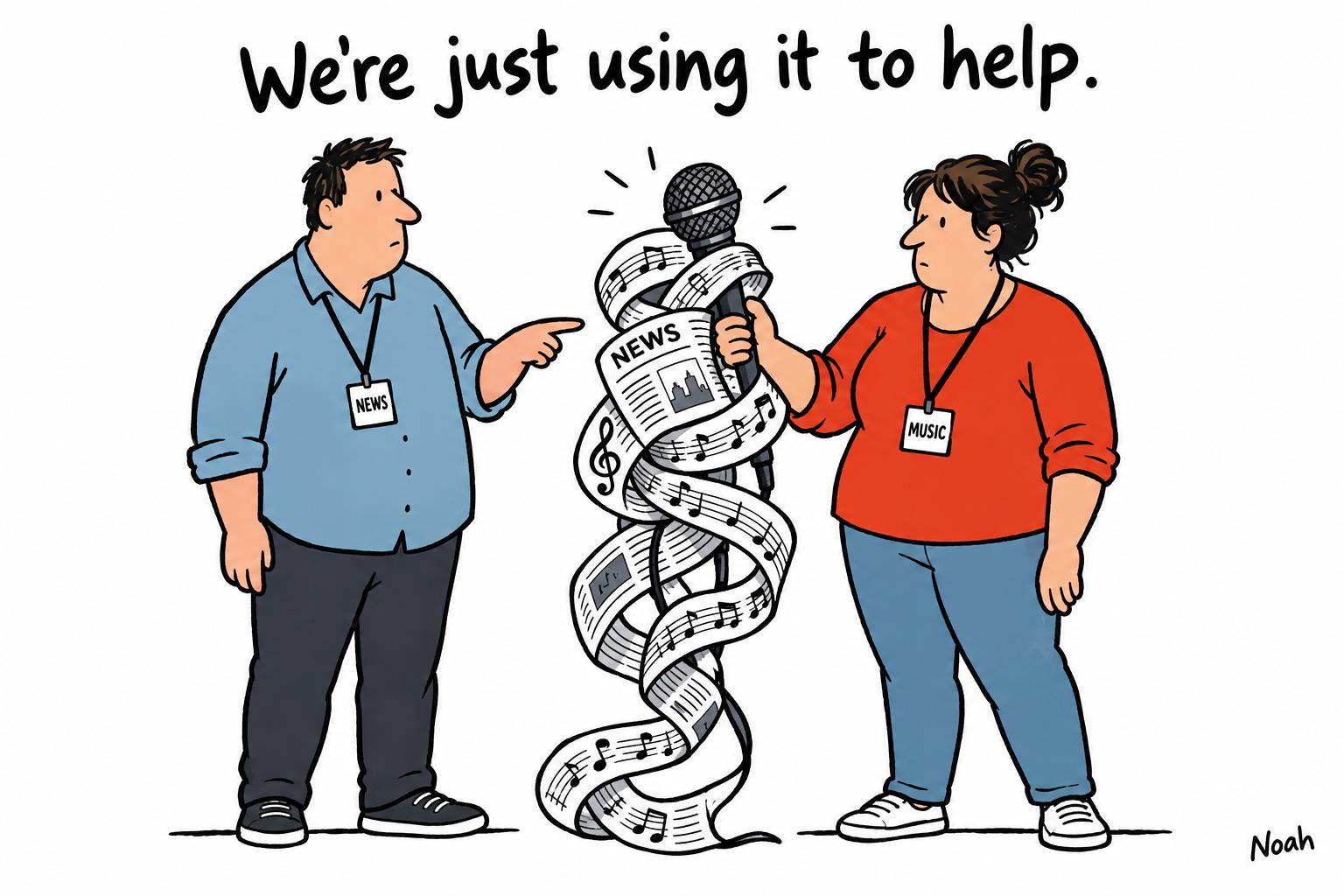
Louisville Public Media says it is making its approach to artificial intelligence public as the technology becomes more prominent in media and raises questions about trust, accuracy and the future of newsroom work. In a statement, president and chief executive Kenya Young said the organisation is beginning to use AI for selected tasks behind the scenes, while insisting that its journalism and programming remain under human direction.
The organisation’s three-year strategic plan places AI within a broader effort to adapt digitally. LPM says it is testing tools for transcription, research and data analysis, with staff reviewing the results. Its stated aim is to reduce time spent on routine work so employees can focus more on reporting, music curation and community engagement.
LPM draws a firm boundary around its editorial work: it says AI will not write its news stories or choose the music played on its stations, and that it will not broadcast AI-generated music. It also rules out using the technology to imitate someone’s voice or modify authentic audio, photographs or video. The organisation says accuracy takes precedence and staff remain responsible for any work assisted by AI.
That position comes amid wider industry tensions over automation and employment. TheWrap reported that more than 90 McClatchy journalists were affected by layoffs in September 2026, as the company faced staff objections to an AI tool designed to repurpose existing reporting. The report describes those developments at McClatchy; it does not establish that AI caused the job cuts.
LPM’s statement also touches on data-centre growth in Kentucky, where the expansion of AI and other digital services is contributing to debate over infrastructure and community impacts. A University of Kentucky guide says data-centre proposals can bring construction, tax revenue and investment, but may also raise questions about electricity, water, land use and transport. The university’s Energy Planning and Inventory Commission reports a substantial pipeline of possible projects, while cautioning that some proposals remain uncertain. WKYT has reported concerns from residents and officials over transparency, infrastructure costs and who may bear them.
The organisation says it has received support from technology-sector funders, including the Google News Initiative and the OpenAI Foundation’s People-First AI Fund, but says such contributions do not affect its coverage or programming choices. Its public-facing work spans WFPL News, WUOL Classical, WFPK Music and KyCIR Investigations, according to LPM’s latest-news page. Young’s statement presents the guiding principle as continuity: people will remain responsible for the organisation’s stories, music, concerts and programmes, with AI serving as an aid rather than a replacement.
Source Reference Map
Inspired by headline at: [1]
Sources by paragraph:
- Paragraph 1: [2]
- Paragraph 2: [2]
- Paragraph 3: [2]
- Paragraph 4: [6]
- Paragraph 5: [3], [4], [5]
- Paragraph 6: [2], [7]
Source: Noah Wire Services