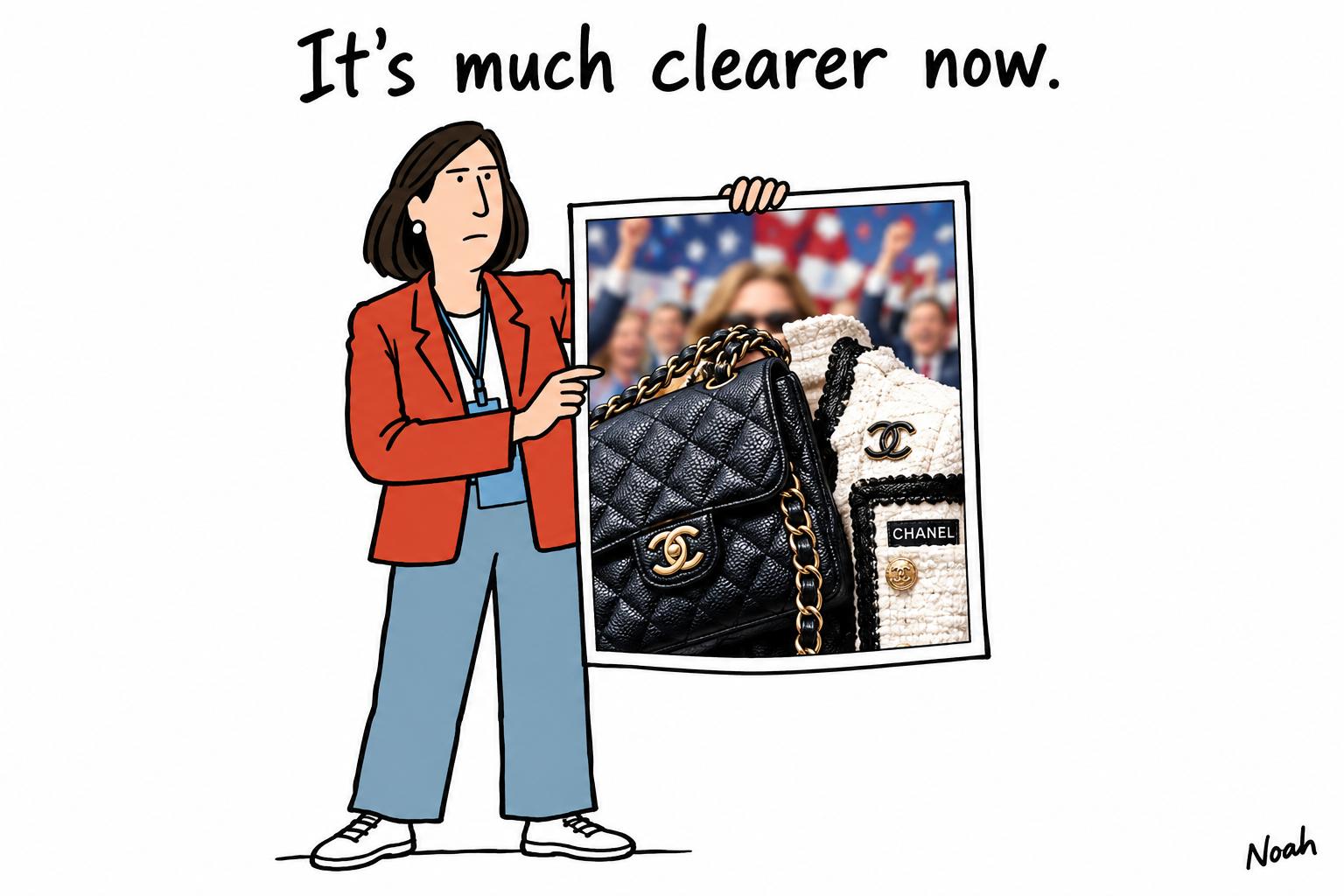
Olivia Reingold, a writer for the Free Press, has acknowledged using ChatGPT to process a photograph she posted from Abdul El-Sayed’s Michigan Senate victory celebration. The image accompanied her claim that she had spotted luxury labels among those attending the event. Its unusual-looking details prompted questions about whether the picture had been altered.
Reingold’s post named Valentino shoes, a Chanel handbag, a Moncler jacket and Rolex watches. Vanity Fair’s fashion correspondent José Criales-Unzueta later drew attention to apparent inconsistencies in the bag and shoes, including irregular straps and proportions that seemed unlike the brands’ designs. The publication said AI-detection tools indicated that OpenAI technology had been used, while noting that neither Chanel nor Valentino had independently confirmed the items’ authenticity.
Reingold subsequently said she had asked ChatGPT to “brighten and sharpen an image of a woman in Valentino shoes and a Chanel bag”. She maintained that the woman and the accessories were real. Defector’s Tom Ley reported that he had contacted Free Press deputy editor Oliver Wiseman to ask whether the publication had rules on AI-generated or AI-altered images, but had received no response by the time his article was published.
The episode highlights a consequential distinction in journalism: software that generatively processes an image may do more than adjust its appearance, potentially introducing or changing visual details. The A.V. Club noted that conventional editing tools can alter brightness and sharpness without using generative AI. The Associated Press, whose standards were updated in July 2026, bars generative AI from creating, altering or enhancing news photography, while allowing some uses of AI for other newsroom tasks subject to human review. That policy is an example of one organisation’s approach, not evidence of the Free Press’s rules.
The photograph appeared amid a politically charged celebration. The Associated Press reported that El-Sayed’s victory drew particular significance for Arab and Muslim Americans, and that his speech included Arabic expressions such as “habibi”, a term of affection also used casually to mean “buddy” or “pal”. Reuters Connect’s transcript records him addressing Vice-President JD Vance as “JD, habibi” and joking about Vance’s constitutional role in swearing newly elected senators into office.
Criales-Unzueta’s broader fashion analysis also questioned the assumption that luxury clothing reliably reveals political allegiance. A handbag or pair of shoes may carry social meaning, but the presence of expensive labels alone does not establish the wearer’s politics. In this case, uncertainty over the image’s processing and the items’ identification complicates the inference Reingold’s post appeared to invite.
Source Reference Map
Inspired by headline at: [1]
Sources by paragraph:
- Paragraph 1: [2], [4]
- Paragraph 2: [3]
- Paragraph 3: [2], [4]
- Paragraph 4: [4], [7]
- Paragraph 5: [5], [6]
- Paragraph 6: [3]
Source: Noah Wire Services