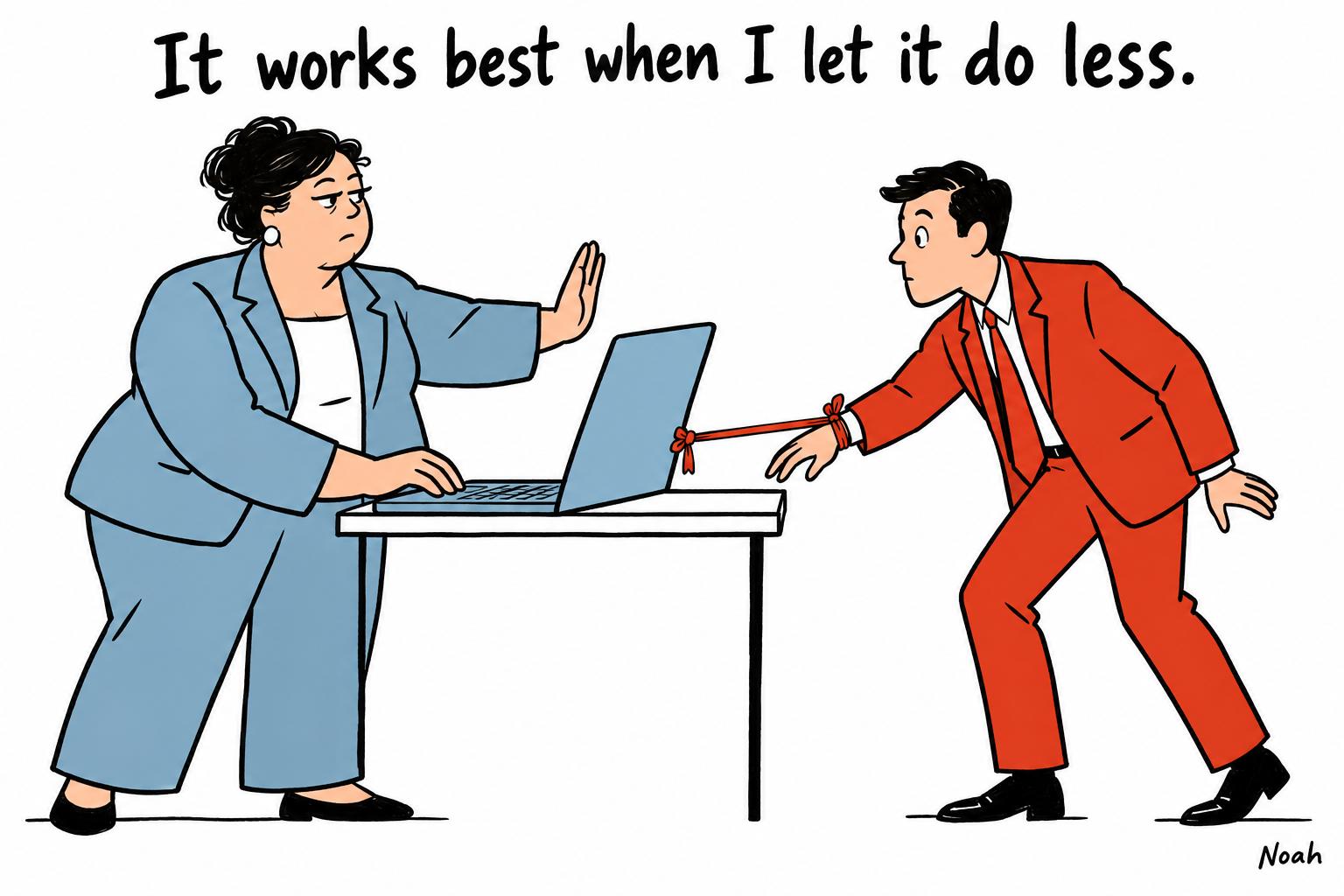
Organisations adopting AI agents should decide in advance what those systems are authorised to do, rather than discovering their capabilities by giving them access and seeing what happens. The distinction matters because a tool can produce convincing answers while making errors that are difficult to spot until someone acts on them.
USA Today’s Digger assistant illustrates the point. In an episode of The Signal, Jessica Davis described how its early responses were accurate roughly three-quarters of the time, with some answers inventing email addresses. Her team improved performance by creating a structured evaluation process and first agreeing what a correct response should contain. The assistant’s progress, as described in the podcast, suggests that reliability depends not only on the model but also on how its performance is tested. (The Signal)
A similar emphasis on boundaries shaped Otto, an internal AI operations assistant developed by Australian publisher Man of Many. At the World News Media Congress, Fathm co-founder Tom Trewinnard discussed the project as part of WAN-IFRA’s Newsroom AI Catalyst programme. The safeguards prevent agents from changing active advertising campaigns, sending emails or publishing articles, keeping consequential decisions under human control. WAN-IFRA reports that the publisher estimates annual savings of about US$6,000 on enterprise subscriptions and says senior leadership meetings have been shortened from more than two hours to 15 minutes. (WAN-IFRA)
Man of Many has also set conditions for external AI assistants that access its journalism. Its public Model Context Protocol connector is free to use and does not require an account, but it is read-only: assistants receive excerpts and links to full stories rather than permission to alter or publish material. The connector’s terms prohibit bulk copying and use of the content to train models. The publisher says it records queries, the tools used and a hashed IP address. The arrangement reflects a broader principle: access to content need not mean unrestricted use of it. (Man of Many)
OWASP describes the danger of giving an AI system more ability to act than its task requires as “excessive agency”. Its guidance identifies three possible sources: excessive functionality, excessive permissions and excessive autonomy. An assistant that summarises email, for example, may need to read messages but has no obvious reason to send or delete them. OWASP recommends limiting tools and permissions to what a task needs, enforcing authorisation in connected systems rather than relying on the model to make that judgement, and requiring approval for high-impact actions. It also advocates logging and monitoring, alongside safeguards such as rate limits and circuit breakers. (OWASP)
Human oversight remains important, but checking every output is unlikely to be a workable quality-control system as use expands. A more sustainable approach is to set explicit tests, establish a threshold for acceptable performance and examine the failures those tests expose. That allows staff to concentrate on consequential approvals and on revising safeguards as evidence accumulates, rather than reviewing every routine response. WAN-IFRA’s account of the Catalyst programme also stresses that useful newsroom tools should fit existing workflows and draw on clean, well-organised information. (The Signal; WAN-IFRA)
PayPal offers another example of improvement coming from the system around a model. VentureBeat reported that the company raised the accuracy of an internal data assistant from 43% to 95% without replacing the underlying model. It supplied business definitions, familiar query patterns and analytical procedures, including reusable examples of how employees approach questions. The case underlines why testing must reflect how an organisation actually uses data: retrieving records is not enough if the assistant misunderstands what a business term means. (VentureBeat)
Before deployment, teams should record what an agent may read, what it may change and which actions require a named person’s approval. They should also define how accuracy will be measured, the point at which performance requires the agent to be paused, and who will review its activity logs. These controls cannot eliminate mistakes, but they can make an agent’s authority proportionate to its purpose and help an organisation identify problems before they become consequential. (OWASP; SecurityBrief Australia)
Source Reference Map
Inspired by headline at: [1]
Sources by paragraph:
- Paragraph 1: [2]
- Paragraph 2: [2], [7]
- Paragraph 3: [3]
- Paragraph 4: [4]
- Paragraph 5: [5]
- Paragraph 6: [2], [3], [7]
- Paragraph 7: [6]
- Paragraph 8: [2], [5]
Source: Noah Wire Services