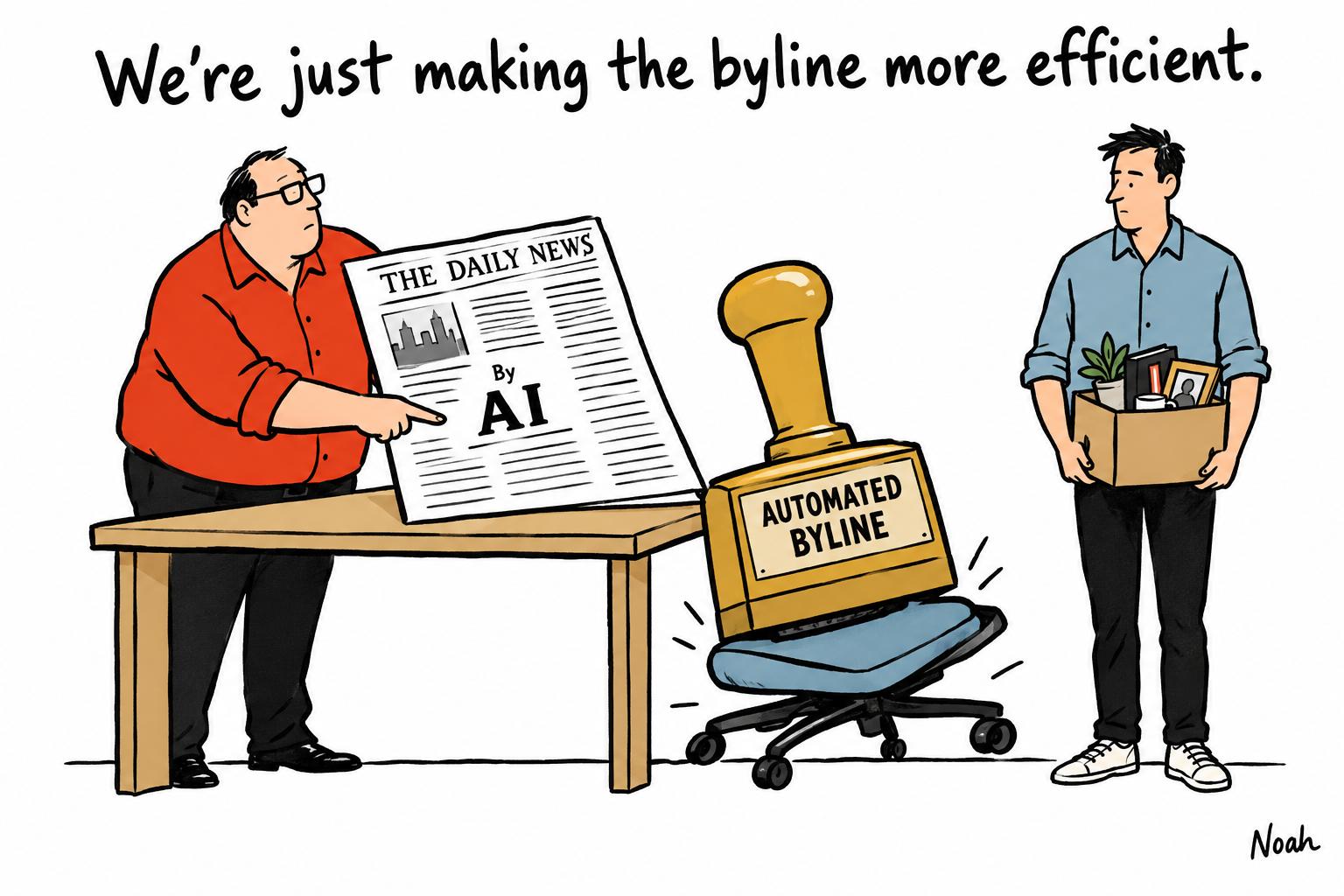
Cryptocurrency publishers are increasingly making artificial intelligence visible in their coverage as the sector contends with sustained pressure on newsroom jobs. Press Gazette’s investigation, introduced in its newsletter by Rob Waugh, describes AI use as part of a wider shift in a specialist media market that expanded during the crypto boom but has since become more difficult for journalists. The newsletter confirms the investigation’s focus, though it does not set out the detailed evidence behind its examples. Decrypt’s AI byline has become a prominent case. Cryptocurrency researcher Andrey Sergeenkov says the outlet’s “Decrypt Agent” began publishing in March and had produced 625 articles by 29 October. Decrypt’s own author page confirms that it uses internal AI agents, describing them as tools to help its editorial team with research, trend analysis and journalism. That account presents the systems as editorial support; it does not say they replace reporters. Sergeenkov, meanwhile, reports that managing editor Andrew Hayward said in July he had been laid off alongside most of the editorial team, and observed that regular human bylines became less frequent over the summer. The chronology has fuelled questions about how the technology relates to staffing changes, but the available material does not establish that the agent took the place of individual journalists. AI-linked publishing is also visible at CoinDesk, whose site has an “AI Boost” author page. That listing shows content associated with the label, but does not reveal how much of any article was generated by AI, what human editing it received or whether the practice replaced staff. The distinction matters: a label or byline can demonstrate that AI is part of a publisher’s output without showing how its newsroom uses the technology. The job losses cited in coverage of crypto media sit within a longer period of retrenchment. Axios reported in 2023 that CoinDesk planned cuts as its parent company, Digital Currency Group, sought to reduce costs and explore a sale; a source told Axios that about 40 per cent of the editorial team, or 18 people, were expected to go. The Block separately reported that 45 per cent of CoinDesk’s editorial staff had been laid off. Those accounts differ on the reported scale, but both describe substantial reductions during a difficult market and a restructuring of the business. Other outlets have also faced reported redundancies, while some are exploring business models built around data and AI tools. Sergeenkov’s account describes Blockworks’ move towards products that allow data to be queried through AI assistants, alongside the closure of its newsroom in October 2025 and staff departure announcements in 2026. Taken together, the examples point to two related but distinct developments: publishers are experimenting with AI-enabled content and services, while crypto journalism continues to absorb workforce cuts. The evidence supports scrutiny of how these changes intersect, but does not by itself show that AI adoption is the cause of the reported redundancies.
Source Reference Map
Inspired by headline at: [1]
Sources by paragraph:
Source: Noah Wire Services