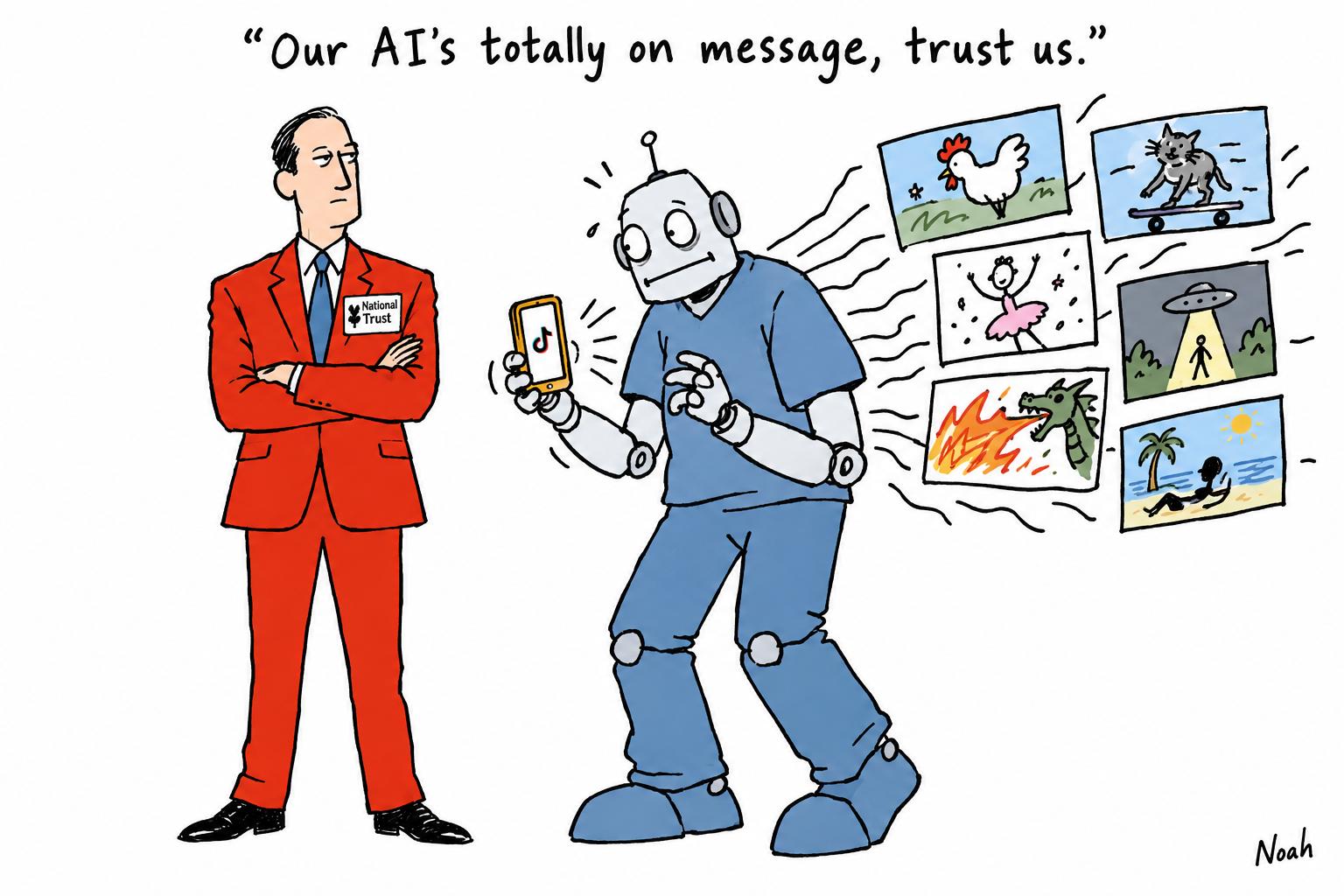
The charity has suspended its TikTok advertising while it investigates how AI-generated promotional material went live without approval.
The National Trust has suspended all advertising on TikTok after a run of AI-generated promotional videos appeared without the charity’s approval, prompting questions about how an automated feature on the platform was allowed to publish material that looked markedly unlike the organisation’s normal campaigns. According to the charity, the adverts were created in error by TikTok Ads and were never meant to go live.
In a statement posted on LinkedIn, the National Trust said it had paused its TikTok activity while it investigated what happened. A spokesperson later told Civil Society that the charity was working directly with TikTok to understand the incident and to put extra safeguards in place so it would not happen again. The pause is set to remain in place while that inquiry continues.
The episode has drawn criticism from marketers who said the AI-made videos sat awkwardly beside the National Trust’s established identity and its broader environmental and climate campaigning. Charlotte Anstee, a digital marketing executive at Ocean, wrote on LinkedIn that she was surprised the material had slipped through, saying local social media teams had previously been told there was an AI ban. Alex Pollard, managing director of Pollard Media, told Civil Society that the situation was especially striking given the charity’s extensive image archive and its reputation for promoting real landscapes and historic places.
The controversy also reflects wider unease about automated creative tools increasingly being built into advertising platforms. Harri Brown, co-founder of Antler Social, told Civil Society that advertisers using TikTok’s paid business tools can avoid unexpected AI-generated assets by disabling the setting that automatically adds newly generated material during delivery. He added that any AI assets already inserted into an ad group can be removed manually. The National Trust’s case now stands as another example of how quickly platform automation can overtake brand control if safeguards are not properly managed.
Source Reference Map
Inspired by headline at: [1]
Sources by paragraph:
Source: Noah Wire Services
Noah Fact Check Pro
The draft above was created using the information available at the time the story first
emerged. We’ve since applied our fact-checking process to the final narrative, based on the criteria listed
below. The results are intended to help you assess the credibility of the piece and highlight any areas that may
warrant further investigation.
Freshness check
Score:
8
Notes:
The article was published on October 17, 2026, and reports on events from October 13, 2026. The earliest known publication date of similar content is October 13, 2026, indicating that the narrative is fresh. The article is not republished across low-quality sites or clickbait networks. The narrative is based on a press release from the National Trust, which typically warrants a high freshness score. No discrepancies in figures, dates, or quotes were found. The article includes updated data and does not recycle older material. Overall, the freshness score is high.
Quotes check
Score:
7
Notes:
The article includes direct quotes from a National Trust spokesperson and digital marketing executives. The earliest known usage of these quotes is from October 13, 2026. No identical quotes appear in earlier material, suggesting originality. However, the quotes cannot be independently verified, as no online matches were found. Unverifiable quotes should not receive high scores.
Source reliability
Score:
6
Notes:
The narrative originates from a major news organisation, TechRadar, which is a strength. However, the article is summarising, rewriting, or aggregating content from other publications, including Civil Society and Charity Times. This indicates a lack of original reporting and raises concerns about source independence. The lead source appears to be summarising content from paywalled publications, which is a significant concern. The source's limitations and reach are noted, and the score is reduced accordingly.
Plausibility check
Score:
7
Notes:
The article reports on the National Trust's suspension of TikTok ads due to AI-generated content errors, which is plausible and aligns with industry trends. The narrative is covered by other reputable outlets, including Civil Society and Charity Times. The report includes specific factual anchors, such as the National Trust's statement and quotes from digital marketing executives. The language and tone are consistent with the region and topic. No excessive or off-topic detail is included. The tone is appropriate for corporate communication. Overall, the plausibility score is high.
Overall assessment
Verdict (FAIL, OPEN, PASS): REVIEW
Confidence (LOW, MEDIUM, HIGH): MEDIUM
Summary:
The article reports on the National Trust's suspension of TikTok ads due to AI-generated content errors. While the narrative is fresh and plausible, it relies heavily on summarised content from paywalled publications, raising concerns about source independence and verification. The quotes cannot be independently verified, further diminishing the reliability of the information. Given these issues, a REVIEW verdict is appropriate, and further editorial scrutiny is recommended before publishing.