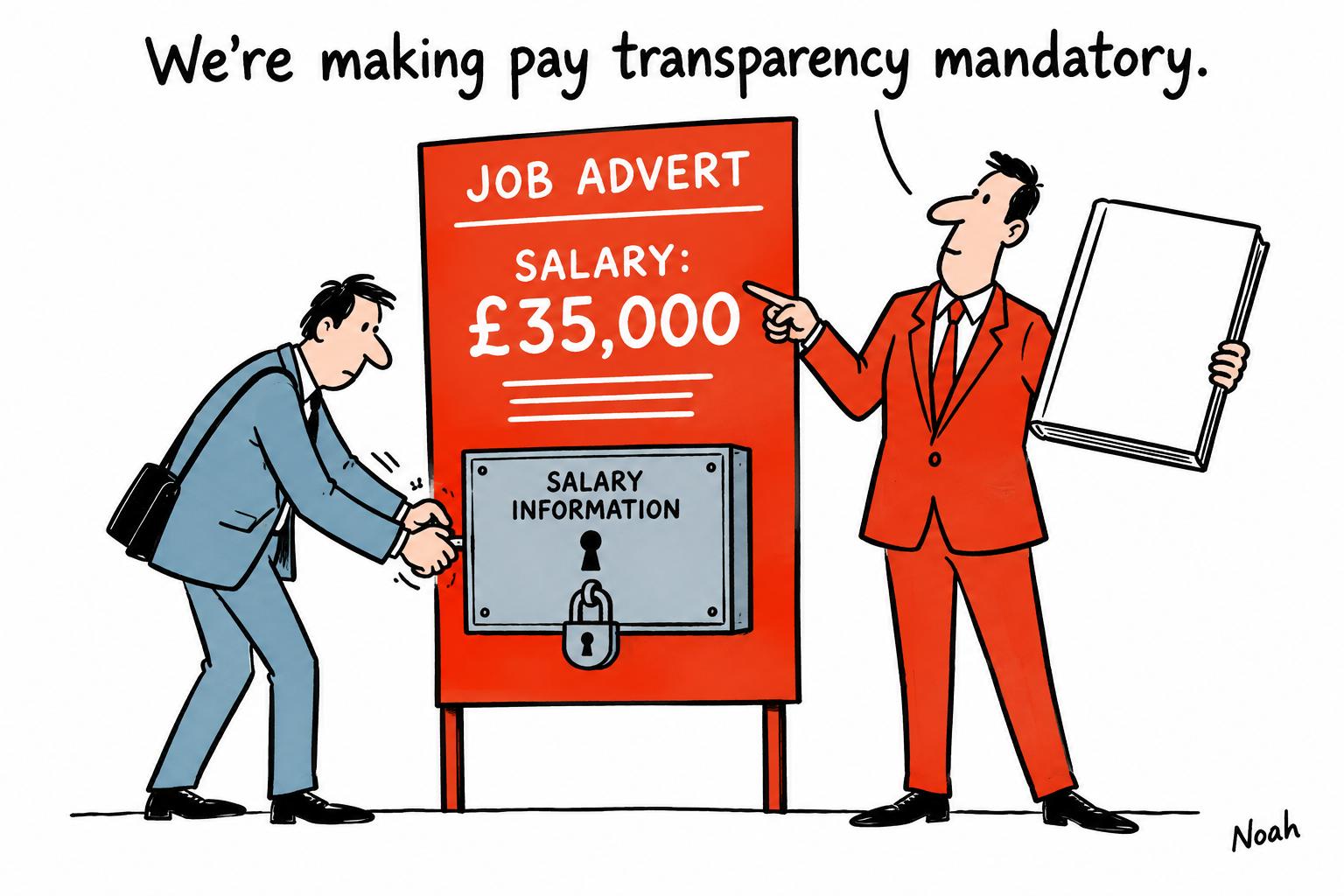
The proposed requirement aims to help applicants assess jobs and compare pay, but ministers have yet to set out which employers it will cover or how the rules will be enforced.
Andy Burnham’s government plans to require employers to state pay in job advertisements, arguing that applicants should be able to judge a role before committing time to an application. The proposal is also intended to make it easier for workers to compare their own pay with that of colleagues and to identify possible disparities.
Burnham said the change mattered to people starting their careers as well as parents supporting families. He said: “Whether you’re a young person starting out or a parent trying to support your family, you should know what a job pays before spending your time and effort applying for it. That’s why we will make it a legal requirement for all employers to say what you pay.” The government has yet to specify which employers will be covered, what pay details they must provide or how compliance will be enforced.
The policy responds to a widespread lack of clear pay information in recruitment. Research from the Chartered Institute of Personnel and Development found that 41% of surveyed employers always include salary ranges in external job adverts. The government’s announcement also cited a figure of 18% for employers that always publish specific salaries. The CIPD cautions that its measures cover different forms of disclosure, and recommends that employers using pay scales explain where a successful candidate is likely to start and how their salary could progress.
Supporters say clearer information could help address unequal pay by giving candidates a better basis for assessing offers. The government argues that secrecy can leave applicants negotiating without knowing the expected rate, potentially reinforcing unjustified differences. International analysis by the OECD likewise identifies salary disclosure as one way to improve candidates’ information, while warning that its impact depends on how rules are designed; an unusually broad salary range, for example, may offer little practical guidance.
The proposal forms part of a wider review of equal-pay protections. A government consultation considered requiring employers to disclose pay in adverts, or to provide the information before interview when a vacancy was not advertised. It also sought views on possible future protections for disabled people, ethnic minorities and outsourced workers. Ministers have not yet published final decisions on those wider issues, and the precise requirements for recruitment disclosure remain to be settled.
Burnham has presented the measure as one of a series of practical changes, alongside a broader programme of reform that he says will address the legacy of four decades of neoliberalism. The government has also linked its employment agenda to opportunities for young people, with further measures expected following a review by former minister Alan Milburn. In its announcement, it said employers should disclose pay voluntarily while legislation is prepared.
Paul Nowak, general secretary of the Trades Union Congress, said: “Anyone who’s searched for a job knows how frustrating it is to read ‘competitive salary’.” Evidence from a separate UK policy offers some support for the wider case for transparency, though it does not test the proposed advertising rule directly: research on mandatory gender-equality reporting by large firms found a reduction in the gender pay gap and an increase in employers’ likelihood of including wages in vacancy adverts. The findings relate to a different disclosure policy, so they do not establish what effect the new requirement would have.
Source Reference Map
Inspired by headline at: [1]
Sources by paragraph:
Source: Noah Wire Services
Noah Fact Check Pro
The draft above was created using the information available at the time the story first
emerged. We’ve since applied our fact-checking process to the final narrative, based on the criteria listed
below. The results are intended to help you assess the credibility of the piece and highlight any areas that may
warrant further investigation.
Freshness check
Score:
7
Notes:
🕰️ The core announcement is recent: the cited GOV.UK press release is dated 5 November 2026, and the Guardian article is dated 6 November 2026. The earliest confirmed source located for the policy announcement is that official release; I found no confirmed substantially similar coverage more than seven days earlier. However, the submitted copy is not demonstrably original reporting: its headline is explicitly described as inspired by the Guardian, and several central facts and the Burnham quotation closely follow the Guardian article and government release. Treat this as a fresh announcement presented in derivative form, not as an independently originated story. The longer-term policy background and research cited are older material, appropriately presented as context rather than as new findings.
Quotes check
Score:
8
Notes:
✅ The Andy Burnham quotation is directly verifiable in the GOV.UK release published 5 November 2026 and also appears in the Guardian report dated 6 November. The submitted wording matches those sources, including the wording about a young person or parent and making disclosure a legal requirement. Paul Nowak’s short quotation is present in the Guardian article, but I did not find it in the retrieved portion of the government release; its original setting and wording therefore have less independent confirmation here. Because the article appears to draw on the Guardian and the official release, quote accuracy is supported, but the reuse of identical wording should be disclosed and independently checked before publication.
Source reliability
Score:
5
Notes:
⚠️ The underlying announcement is supported by an official GOV.UK press release, and the Guardian article provides a named reporter and a report published 6 November 2026. The submitted item, however, is attributed to Noah Wire Services, a research and story-development service whose own terms say its material is for editorial consideration and requires competent editor review; that is not equivalent to an independent news organisation verifying and publishing the story. The source map points repeatedly to the Guardian and to government material, suggesting a derivative rewrite rather than original reporting. No separately reported investigation or named independent source for the policy details is supplied. The sources are verifiable, but the submitted outlet and its reporting process do not warrant high confidence on their own.
Plausibility check
Score:
6
Notes:
⚠️ The main announcement and its 41% and 18% figures appear in the official 5 November 2026 release. The article correctly signals that the policy's coverage, required pay details and enforcement are not yet specified; do not present it as an enacted law or as a fully settled scheme. The 41% and 18% statistics are government-reported estimates attributed to the CIPD, but they measure different forms of disclosure and should not be conflated. The cited academic study concerns mandatory gender-equality reporting at large firms, not the proposed job-advert rule; the article usefully acknowledges that it does not directly test this proposal. The claim that Burnham is prime minister and the wider political context are highly consequential and deserve direct confirmation against authoritative records before publication; the supplied sources largely repeat the same announcement rather than independently establishing that broader context.
Overall assessment
Verdict (FAIL, OPEN, PASS): REVIEW
Confidence (LOW, MEDIUM, HIGH): MEDIUM
Summary:
⚠️ The policy announcement is supported by a GOV.UK release dated 5 November 2026 and was reported by the Guardian on 6 November, so the underlying news appears fresh. However, the submitted copy is explicitly linked to the Guardian as its headline inspiration and closely follows the Guardian and government wording; Noah Wire's own description of its service also calls for editor review. The article should not be treated as independent original reporting without a substantial source check and editorial rewrite. ✅ The Burnham quotation and the reported employer-disclosure figures can be checked against the official release, while the CIPD, OECD and academic material provide relevant but limited context. ⚠️ The policy's scope, disclosure requirements and enforcement remain unsettled, the 18% and 41% measures are distinct, and the cited study does not test this proposed rule. No confirmed paywall was found, though the Guardian's subscription prompts and possible derivative use merit rights review. Confirm the wider political claims and assess source attribution before publication.