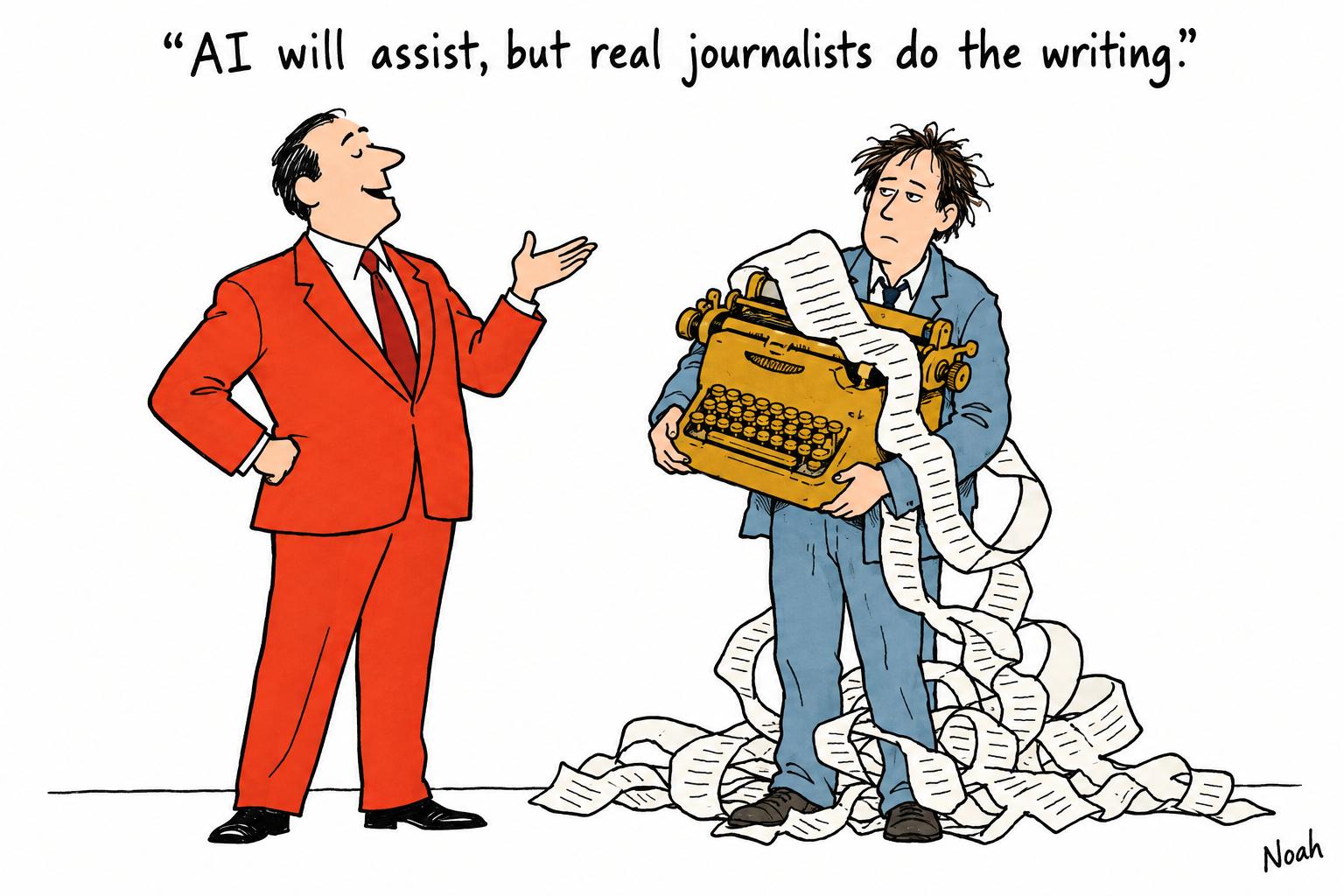
The Seattle Times says AI will remain a limited, supervised newsroom tool rather than replace reporters, as the newspaper challenges Microsoft and OpenAI over the use of its journalism.
The Seattle Times has drawn a bright line around artificial intelligence: it says it does not publish news reports written by machines, and it has no intention of shifting towards an AI-led newsroom. In a note to readers posted on its website, the paper said journalism depends on human judgement, verification, context and relationships, and warned that those qualities cannot be replicated by automated systems.
The message was framed not as a rejection of technology altogether, but as an argument for caution. The paper said it has moved slowly and selectively, using AI only in limited ways and always under editorial oversight. One example is its weekly News Quiz, where the technology helps with drafting and formatting before a human editor makes the final selections. The site also says it uses an audio player that can read stories aloud, and that these are the only reader-facing AI tools it currently offers.
Behind the scenes, The Seattle Times said it occasionally uses AI to transcribe interviews, organise data in investigations and scan public meeting videos for possible story leads. Even then, it stressed that reporters must verify any findings themselves. The paper also said its business teams are experimenting with limited back-end uses, such as advertiser lead generation, while newsroom use of AI remains subject to approval by senior editorial leadership.
The paper’s stance comes amid wider industry anxiety over how generative AI is reshaping media economics and editorial standards. In September 2026, The Seattle Times and Newsday filed a copyright lawsuit against Microsoft and OpenAI, alleging that the companies trained models on large volumes of their journalism without permission, including material behind paywalls. Reports on the case said the publishers were seeking damages and the destruction of datasets and models built with their work, while also warning that AI-generated content could undercut the value of original reporting.
The newspaper said its internal policy, first drafted in 2023 and most recently updated in March, is meant to keep the newsroom on the defensive as the technology evolves. It emphasises transparency, scepticism and the obligation to verify information before publication. Ryan Blethen, who became publisher in January, told a concerned reader that AI should support journalism rather than replace it, a view that reflects the newspaper’s broader effort to preserve a large reporting staff in a market where news organisations are under growing pressure from automation and changing audience habits.
Source Reference Map
Inspired by headline at: [1]
Sources by paragraph:
Source: Noah Wire Services
Noah Fact Check Pro
The draft above was created using the information available at the time the story first
emerged. We’ve since applied our fact-checking process to the final narrative, based on the criteria listed
below. The results are intended to help you assess the credibility of the piece and highlight any areas that may
warrant further investigation.
Freshness check
Score:
8
Notes:
The article was published on October 18, 2026, referencing events from September 2026. The lawsuit filed by The Seattle Times and Newsday against OpenAI and Microsoft is a recent development, with the earliest known publication date of similar content being September 4, 2026. The article appears to be original, with no evidence of recycling or republishing across low-quality sites. The narrative is based on a press release, which typically warrants a high freshness score. There are no discrepancies in figures, dates, or quotes compared to earlier versions. The article includes updated data and does not recycle older material. Overall, the freshness score is high, with no significant concerns.
Quotes check
Score:
7
Notes:
The article includes direct quotes from The Seattle Times' President and CEO Alan Fisco, as well as a Microsoft spokesperson. The earliest known usage of these quotes is from the lawsuit coverage published on September 4, 2026. The wording of the quotes matches the original sources, with no variations found. However, the quotes cannot be independently verified through other reputable sources. While the quotes are consistent with the original sources, the lack of independent verification slightly reduces the score.
Source reliability
Score:
9
Notes:
The article originates from The Seattle Times, a major news organisation known for its credibility. The content is not summarising, rewriting, or aggregating material from another publication. There is no evidence of the lead source being derived from a paywalled source. The source's limitations and reach are not a concern in this case. Overall, the source reliability score is high, with no significant issues identified.
Plausibility check
Score:
8
Notes:
The article reports on a lawsuit filed by The Seattle Times and Newsday against OpenAI and Microsoft, alleging unauthorized use of their journalism to train AI models. This claim is corroborated by multiple reputable sources, including GeekWire and TechCrunch. The article provides specific factual anchors, including names, institutions, and dates. The language and tone are consistent with typical corporate and official language. There is no excessive or off-topic detail unrelated to the claim. The tone is appropriately formal and factual. Overall, the plausibility score is high, with no significant concerns.
Overall assessment
Verdict (FAIL, OPEN, PASS): PASS
Confidence (LOW, MEDIUM, HIGH): HIGH
Summary:
The article meets verification standards with high confidence. It is a recent, original news report from a reputable source, with consistent and plausible claims. While some quotes cannot be independently verified, the overall credibility of the article remains strong.