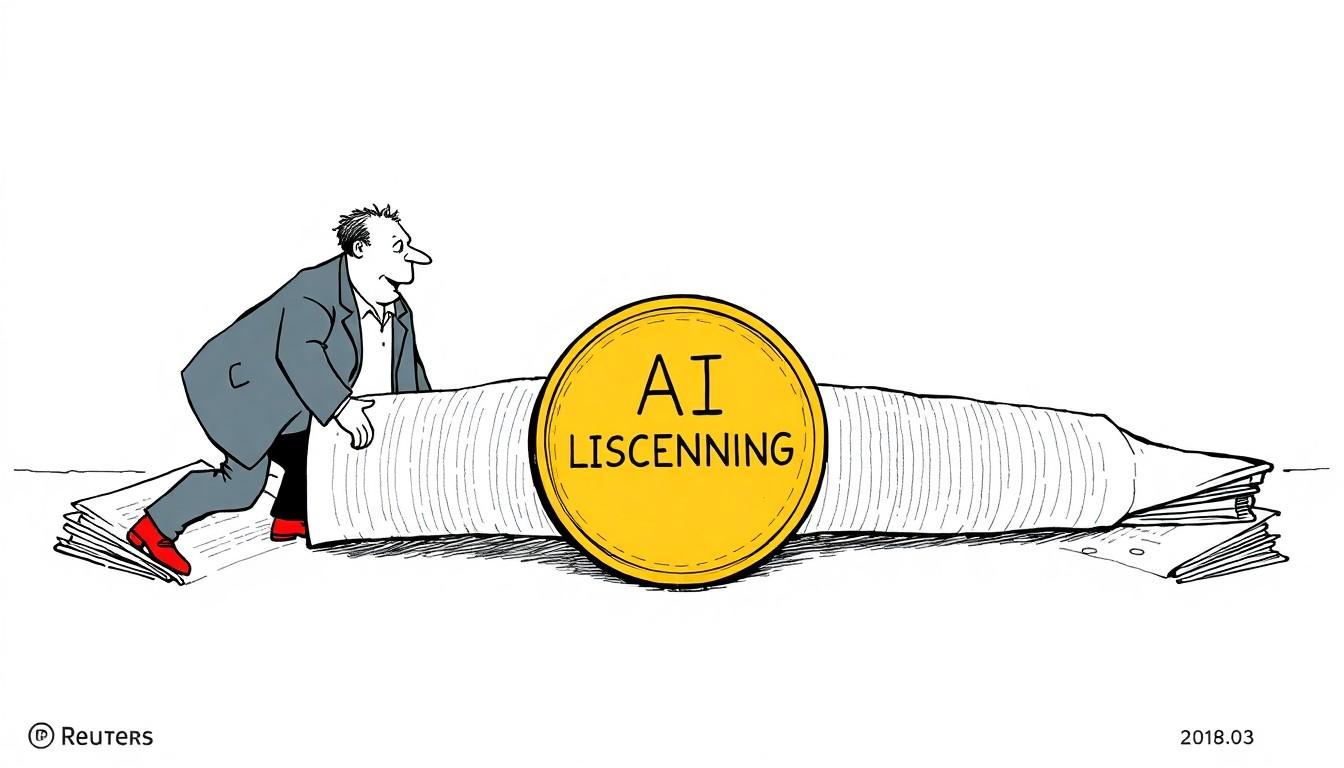
Reuters journalists in the United States have authorised their union to call a strike as contract negotiations continue, putting the distribution of artificial intelligence revenue among the issues in dispute. The NewsGuild says members are seeking stronger protections around AI, alongside better pay and limits on managers doing work covered by the union contract. Authorisation does not mean a strike has begun; it gives union representatives the power to call one if talks fail.
The dispute comes as Reuters’ owner, Thomson Reuters, reports a sharp rise in the news agency’s revenue. Its third-quarter results put Reuters revenue at about US$232 million, up 12 per cent on an organic basis. The company attributed the increase chiefly to higher generative AI content-licensing revenue, while also citing contributions from other businesses and a contractual price rise in a news agreement. The figures establish that licensing has contributed to growth, but the company has not disclosed how much came from particular deals or how that income might be shared with journalists.
Reuters has struck an arrangement with Meta to provide news content for answers generated by Meta AI, Axios reported in 2024, citing people familiar with the agreement. The report did not establish whether the deal also covered training Meta’s language model, nor did it disclose its financial terms. That distinction matters: licensing journalism for use in AI-generated answers is not necessarily the same as granting permission to train a model on that material. The supplied newsletter also says Reuters has a deal with Microsoft, but the available reporting does not detail its terms.
The question of who benefits from AI licensing extends beyond Reuters. Poynter has examined proposals for statutory licensing, under which AI developers would pay for the use of copyrighted journalism, as well as the private agreements publishers have negotiated with technology companies. Such deals may bring money to media organisations, but they do not, by themselves, guarantee that reporters whose work is licensed will receive a share. The Reuters negotiations therefore raise a wider issue for the industry: whether new income from AI use should flow only to publishers, or also to the people producing the journalism.
The pressure to find new revenue is unfolding alongside a turn towards automation at other publishers. McClatchy, the owner of titles including The Miami Herald and The Sacramento Bee, is developing Project Catalyst, an AI-focused operating model that includes automating routine work and launching lifestyle and shopping websites. Nieman Lab reported that executives presented the plan as a response to financial strain and a way to generate cash to sustain the business. The strategy illustrates a different response to the economics of AI: rather than negotiating how licensing income is distributed, publishers may seek to reduce costs by changing how work is done. Whether that approach can protect the reporting on which news organisations depend remains uncertain.
The stakes also extend beyond employment and revenue. In a report on covert testing of ChatGPT, Claude, Gemini and Grok, the US Government Accountability Office said testers were able to get past initial safeguards and obtain information that could assist with planning attacks, including scenarios involving explosives and the electricity grid. The agency said each platform produced relevant information in less than 12 hours, while noting that the results came from specific tests and that timings could vary. Its findings underline the difficulty of ensuring that AI systems remain useful without enabling harmful requests, one reason the Reuters dispute concerns not only who earns from the technology, but how its use is governed.
Source Reference Map
Inspired by headline at: [1]
Sources by paragraph:
- Paragraph 1: [3]
- Paragraph 2: [4]
- Paragraph 3: [7]
- Paragraph 4: [2]
- Paragraph 5: [5]
- Paragraph 6: [6]
Source: Noah Wire Services