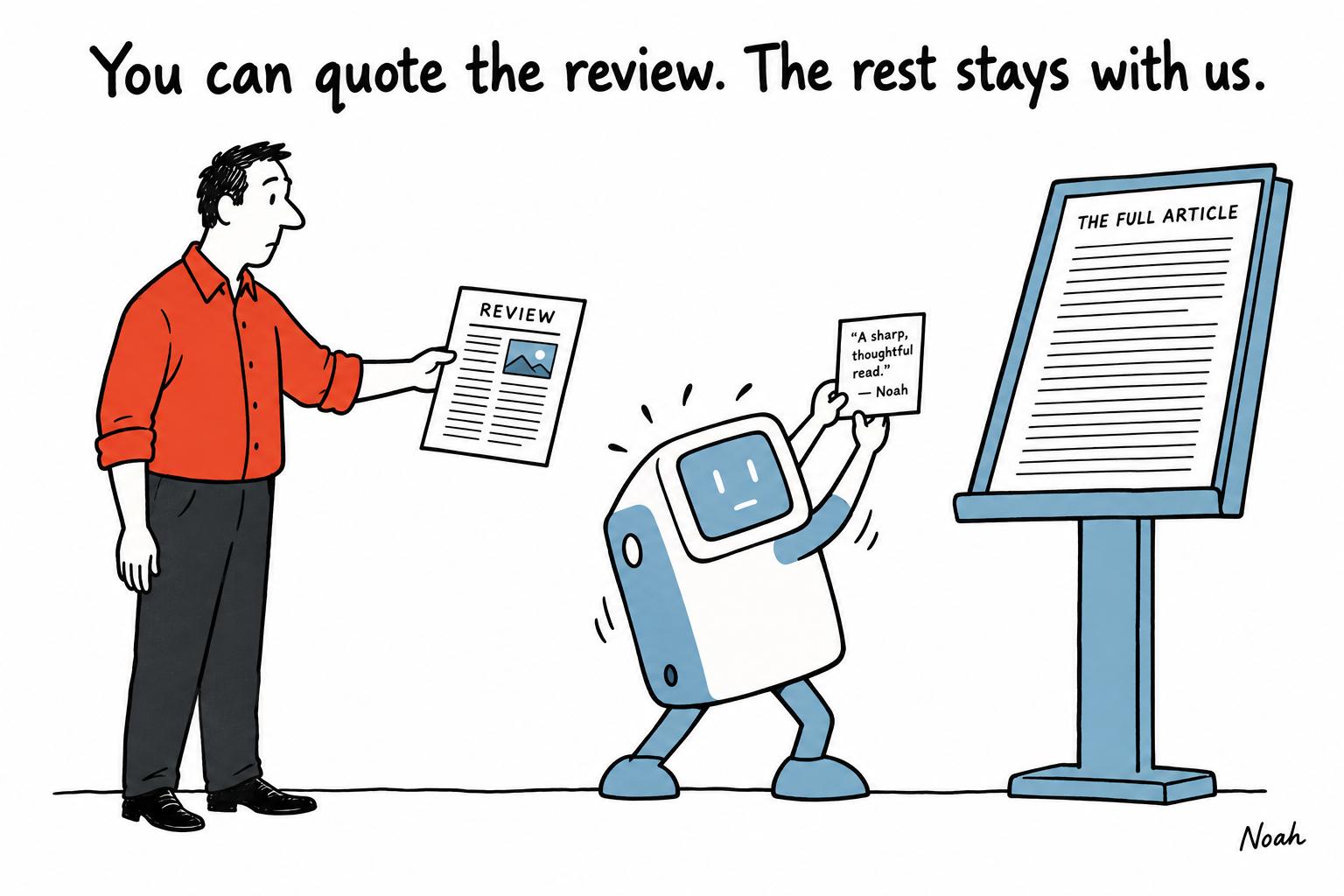
Man Of Many has introduced a public connection that lets compatible AI assistants draw on selected parts of its journalism, including product reviews, buying advice and deals. The Australian publisher says the free service is designed to return short extracts with author credit and links to the complete articles, giving users a route from an AI-generated recommendation to the reporting behind it.
The connector uses the Model Context Protocol, or MCP, an open standard for linking AI applications with external information sources. Anthropic, which introduced the protocol, describes it as a shared framework through which servers make data and tools available to AI clients. In this case, Man Of Many’s server determines which editorial material and functions an assistant can access.
According to B&T, the service is anonymous, requires neither an account nor an API key, and cannot alter or publish anything on the publisher’s website. Man Of Many’s information page lists seven functions, including searching for and retrieving articles, finding recent stories, consulting buying guides, recommending products, suggesting gifts and locating deals. The publisher says results can include product details and links, depending on the material available in its coverage.
The intended use is practical discovery: a reader might ask an assistant to compare watches within a budget, find a present or explore recent car coverage. Man Of Many co-founder Scott Purcell said: “People are already asking AI what watch to buy and what to give their dad for Christmas. The question is whose reporting answers them,” B&T reported. “We’d rather AI quote a journalist who has actually tested the product and send the reader back to the source.” The publisher’s terms say the service does not permit bulk copying or the use of its content to train or fine-tune AI models.
The launch reflects a broader shift in how publishers are trying to manage the appearance of their work in AI answers. The Reuters Institute has reported that news organisations are weighing the risk of losing website visits or seeing their material used without compensation against the possibility that restricting automated access could make their journalism less visible. Structured, attributed access is one way publishers are testing to retain a link to the source while making selected work available to AI tools.
Other media companies are pursuing related approaches. Digiday has reported on People Inc.’s development of custom APIs for editorial material and on experiments by Forbes involving product reviews and MCP. Reuters Agency also offers its own MCP service for accessing Reuters journalism through compatible tools, although it is a separate product with different access arrangements. These examples suggest that machine-readable delivery is becoming one strand of publishers’ response to AI-driven discovery, rather than a model unique to Man Of Many.
Alongside the server, Man Of Many has announced commercial offerings aimed at brands, including a report on how AI assistants describe and recommend companies, a campaign planner for 2027 and an expansion of entries for its Man Of Many 100 product list. The publisher presents these initiatives as ways for brands to understand their visibility in AI answers. Its claim to be the first major Australian digital publisher with a publicly available MCP server was reported by B&T; the broader industry reporting points to a fast-developing field, but does not independently verify that priority claim.
Source Reference Map
Inspired by headline at: [1]
Sources by paragraph:
- Paragraph 1: [2], [3]
- Paragraph 2: [4]
- Paragraph 3: [2], [3]
- Paragraph 4: [2], [3]
- Paragraph 5: [5], [6]
- Paragraph 6: [7], [8]
- Paragraph 7: [2], [5], [7]
Source: Noah Wire Services