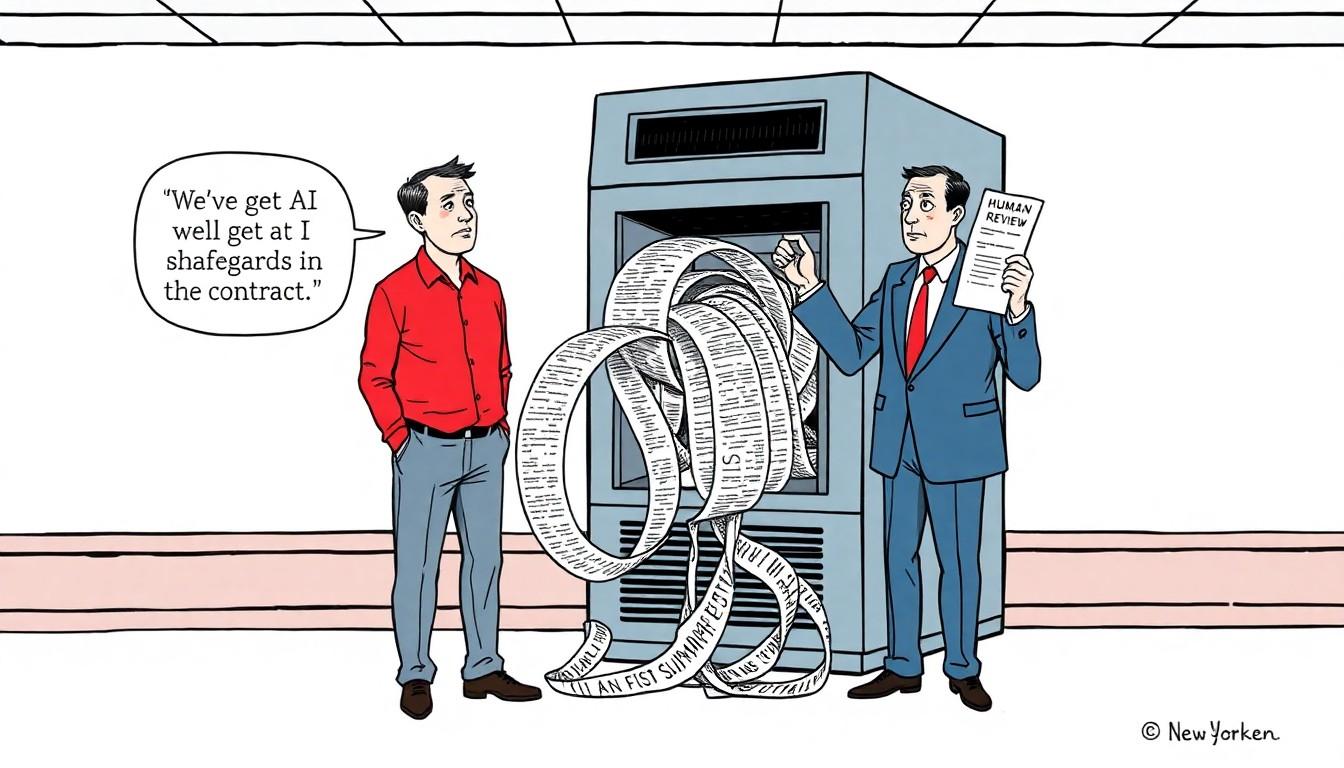
Jon Schleuss says the latest dispute over artificial intelligence in American newsrooms revives an old concern: that owners may value journalism chiefly as material to package and sell. As president of the NewsGuild-CWA, he sees echoes of the strategy pursued at the Los Angeles Times after its parent company adopted the name Tronc. The union’s current focus is USA Today Co., formerly Gannett, where newsroom staff are challenging the company’s use of AI and its partnership with data analytics firm Palantir.
USA Today Co. has promoted a range of automated products, including article summaries, short-form videos and tools intended to help generate stories. The company says Palantir’s work is confined to controlled data and does not give it access to newsroom systems or reporters’ notes. But NewsGuild members have called for the partnership to end, questioning how reader information will be used and protected. They also see a potential conflict of interest in a news organisation working with a company that has served US immigration authorities, subjects regularly covered by its journalists. The union’s concerns describe its members’ position; they do not independently establish what data Palantir can access.
A reader-facing chatbot called DeeperDive has prompted a separate protest. The NewsGuild says journalists at the Akron Beacon Journal and Kent Ravenna Record-Courier planned to withhold their bylines for 14 days from 28 October 2026, objecting to summaries they had not written or checked. The union alleges that the tool made several errors, including identifying a reporter covering a murder case as the suspect. That allegation has not been presented as the finding of an independent technical review. The dispute centres on whether journalists should be associated with material they have not verified, particularly when their employer says computer-generated content should receive human review.
Schleuss says contract terms, rather than management assurances alone, are essential to setting limits on automation. The union’s bargaining priorities include preventing AI-related redundancies or pay cuts, creating joint committees to review new systems, requiring consent before a journalist’s work is used to train or imitate AI, and telling readers when material has been generated by a machine. The New Republic’s agreement, for example, permits generative AI as an adjunct to editorial work but bars its use as the principal means of creating it. It also protects jobs, vacant roles and pay from the effects of AI use. Other negotiated provisions, including those at Ziff Davis, set out more detailed disclosure requirements.
A Politico dispute has illustrated how such contract language can give workers a route to challenge new tools. The NewsGuild says an arbitrator found in November 2025 that Politico had breached its agreement by introducing AI products without the required notice and bargaining. The company later agreed to close its Capitol AI Report-Builder and not revive Live Summaries. The union says the products produced factual errors, including a report-builder response that failed to reflect the Supreme Court’s reversal of Roe v. Wade. The account comes from the workers’ union, which describes the closure as the outcome of the arbitration and subsequent discussions.
The employment context is stark. The Local Journalist Index puts the number of local journalist equivalents in the US at 7.8 per 100,000 residents in 2026, down from about 40 in 2002, an estimated fall of 81 per cent. Its measure is intended to capture reporting capacity, not simply count news outlets or employees. The index also finds that roughly 70 per cent of counties, home to about 209 million people, are below the already low national average. These figures illuminate the stakes of newsroom cuts, though they do not explain the reasons for any particular employer’s decisions.
Schleuss does not argue that every newsroom use of AI is futile. He sees potential in tasks such as transcribing interviews, writing code to gather public data and searching large document collections. The condition, he says, is that journalists check the results rather than treat them as established fact. For the union, that distinction matters as publishers adopt new systems while local reporting capacity contracts: tools may assist journalists, but they cannot substitute for the human judgement and accountability on which reliable reporting depends.
Source Reference Map
Inspired by headline at: [1]
Sources by paragraph:
- Paragraph 1: [2]
- Paragraph 2: [2], [4]
- Paragraph 3: [3]
- Paragraph 4: [2], [5]
- Paragraph 5: [7]
- Paragraph 6: [6]
- Paragraph 7: [2]
Source: Noah Wire Services