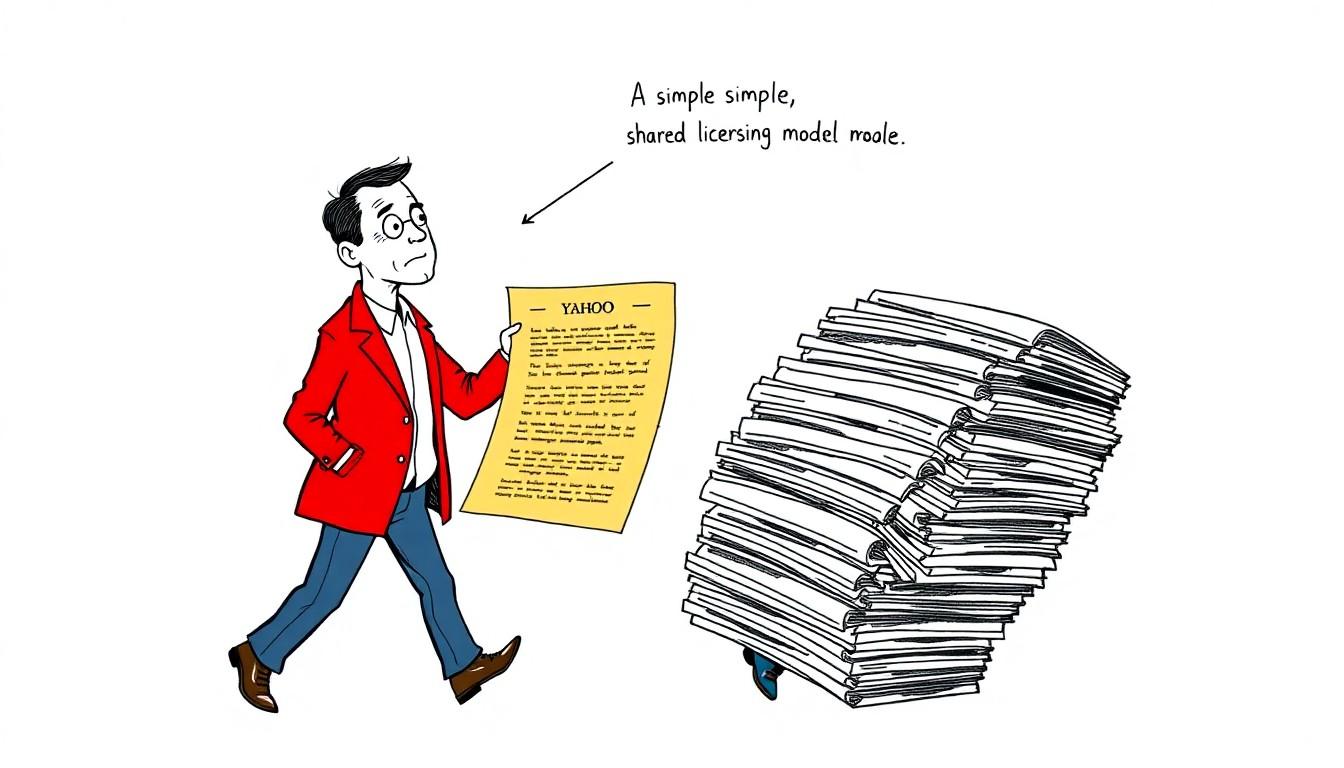
Yahoo has become the first company to take a licence from the Internet Licensing Collective, a publisher-led non-profit that aims to replace separate negotiations with a shared framework for AI content use. The agreement gives Yahoo’s AI-powered search product, Scout, access to participating publishers’ material, with payments intended to reflect the contribution that content makes to its services. Digiday reported that more than 3,000 publishers are part of the collective; ILC’s website puts participation at more than 3,100 media brands, content owners and publishing platforms. (Sources? prohibited parentheses. attribution naturally.)
A licensee pays for access to the collective’s content, with the sum available for publishers tied to the licensee’s revenue. ILC co-founder Doug Leeds told Digiday that this means the compensation pool could expand as a business grows, while also allowing new AI products and companies to join. He declined to disclose the terms of Yahoo’s agreement. The collective says its approach is designed to make licensing workable at scale, reducing the need for AI companies and publishers to negotiate one deal at a time.
The model also separates payments by licensee. Rather than pooling all income and dividing it among every participant, ILC creates a distinct royalty fund for each AI company. That is intended to ensure publishers are paid from the fund associated with products that use their work, and to protect specialist outlets from having their earnings diluted by material used across broad, general-purpose services. ILC says the value of a work, including how it helps shape or ground an AI response, matters more than the size of a publisher’s catalogue.
Within each fund, allocation rules are expected to account for how a publisher’s material is used: whether it is retrieved or used to support an answer, how often the AI relies on it, and whether it is displayed or credited. The precise formula has not been made public. Leeds told Digiday that a specialist health product could generate greater value from a limited body of medical material than a general search service would derive from a much larger volume of content. The framework is intended to reward that difference rather than treat every use as equivalent.
Publishers are also meant to retain control over where their work is licensed. ILC says participants can choose which agreements to approve and can continue to make direct deals outside the collective. Digiday reported that publishers will be able to select licensees through an online portal as more companies join, and to see how their content is being used, including for retrieval-augmented generation or AI training. ILC’s launch announcement describes participation as non-exclusive, allowing publishers to retain existing arrangements.
The collective builds on Really Simple Licensing, or RSL, a separate technical standard for stating rights and conditions in a machine-readable format. The RSL guide describes terms that can cover uses such as AI training and web search, including pay-per-crawl and pay-per-inference arrangements. ILC’s website presents the collective as a licensing organisation, while RSL provides a way for publishers to communicate usage terms to software and crawlers. The organisation’s name change is intended to distinguish the collective licensing operation from the standard itself.
The potential scale of the market remains uncertain. Mather Economics estimates that publisher payments under collective AI licensing could amount to 15 to 35 per cent of AI-company revenue, and says the market could exceed the size of the US display advertising market within three years. Its initial analysis draws on annual revenue run rates from OpenAI and Anthropic, rather than the entire AI sector, and is based on economic modelling and assumptions about the growth of AI demand. The estimate is therefore a forecast, not a guarantee of future payments.
The broader case for collective licensing is that AI systems can use or summarise publisher material without necessarily sending readers to the original sites, weakening the value of referral traffic. In an article for INMA, Mather Economics’ authors describe collective arrangements as one possible way to reduce the cost and complexity of negotiating across many publishers and AI buyers. Leeds told Digiday that individual agreements may bring revenue to particular publishers, but argued that a shared system could help sustain the wider content infrastructure. ILC says it is in discussions with other potential licensees, but has not named them.
Source Reference Map
Inspired by headline at: [1]
Sources by paragraph:
- Paragraph 1: [2], [3]
- Paragraph 2: [2], [3]
- Paragraph 3: [2], [3]
- Paragraph 4: [2], [3]
- Paragraph 5: [2], [7]
- Paragraph 6: [3], [4]
- Paragraph 7: [5], [6]
- Paragraph 8: [2], [5]
Source: Noah Wire Services