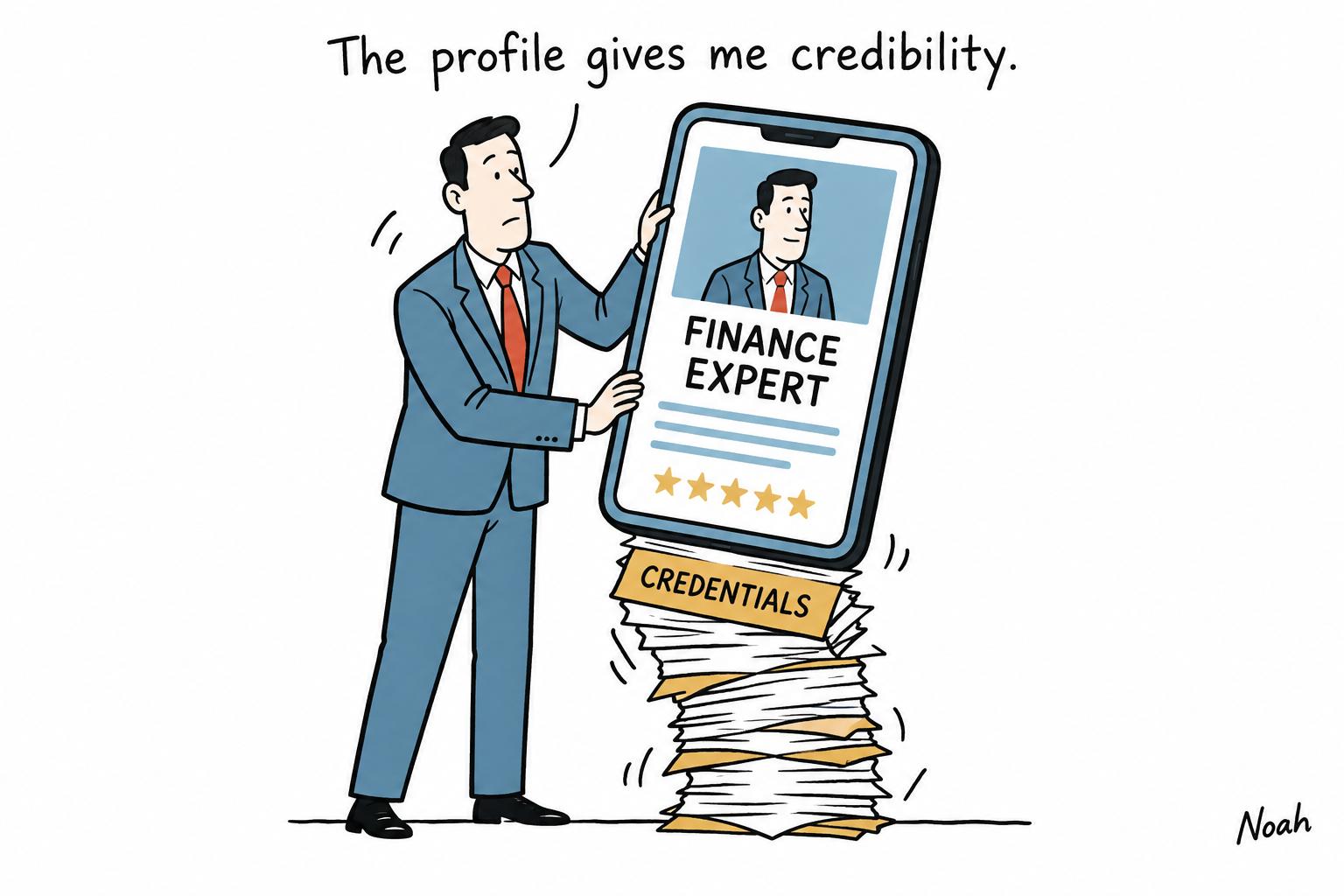
A profile presenting “Sir Patrick Tristram Bijou” as an authority on global finance appeared on the London Post, a website that looks like a local news outlet but has published thousands of articles without naming individual journalists. The man behind the persona, Eric Danison, told the Daily Mail that he had changed his name by deed poll. The Mail reported that Danison was jailed in 2010 for an £14 million property fraud. The profile’s claims about Bijou’s credentials sit within wider questions about who produces the London Post’s content and how it is used.
The outlet’s generic “Ldn-Post” byline and its mixture of routine local items with unusual international stories have also drawn scrutiny from City A.M. In its investigation, the paper described the London Post as part of a wider group of websites owned by 2Trom Media Group, noting that articles often appear to repeat press releases. These features resemble what researchers and journalists call “pink slime”: websites that adopt the appearance of local journalism while publishing material that may be low-quality, politically motivated or designed to advance particular interests.
The concern is not simply whether readers visit such sites. Material published online can be indexed by search engines and drawn into AI-generated answers, allowing unsupported claims to acquire an appearance of authority through repetition. The Daily Mail said ChatGPT described Bijou as a British investment banker, fund manager, author and philanthropist, echoing the London Post profile. City A.M. has also reported that online allegations may be encountered by compliance systems and other services, with potential consequences beyond a website’s direct readership.
The London Post’s publisher has faced a significant legal consequence over another article. City A.M. reported that Uzbek businessman Ovik Mkrtchyan sued 2Trom Media Group and its director, Viktor Tokarev, over claims published by the site concerning corruption and financial wrongdoing. The publisher did not contest the case, and judgment was entered by default. The court awarded Mkrtchyan £105,000 in damages and more than £117,000 in legal costs. As City A.M. noted, the outcome was not a finding reached after a contested trial, but it demonstrates the possible costs of publishing damaging allegations.
Public records establish some details of 2Trom’s corporate officers, while leaving other questions unresolved. Companies House lists Tokarev as an active director and records Mathetes Chihwai, also known as Matthew Martino, as a former director. The register cautions that it does not verify the accuracy of information submitted to it; the filings therefore confirm what was declared, not the truth of broader claims about the company’s operations or connections. City A.M.’s investigation described reported links involving Moscow Media Group and BE Group, but those allegations should be distinguished from the formal company records.
The London Post’s coverage of Tommy Robinson forms another strand of the story. The Daily Mail reported that the site praised Robinson’s book and published an account of his appointment as a goodwill ambassador to a benevolent fund set up by Martino. City A.M. also documented the site’s coverage of that appointment. The material raises questions about the relationships surrounding the outlet, but it does not, by itself, establish who controls its editorial decisions or prove that its publishing is directed by a foreign state.
The phenomenon has a much larger counterpart in the United States. The Columbia Journalism Review’s Tow Center has examined Metric Media, a network of roughly 1,200 sites, describing how local-news formats can be used to promote political messages alongside automated or routine material. Axios, drawing on NewsGuard analysis, reported that at least 1,265 US websites had been identified as backed by dark money or deliberately presenting themselves as local news for political purposes. Those findings provide context for the business model; they do not independently verify allegations about 2Trom or the London Post.
The central difficulty is that a site can borrow the look of community journalism without offering the usual signs of accountable reporting, such as named authors and transparent ownership. When its output is repeated elsewhere or absorbed into automated systems, fabricated credentials and unsubstantiated accusations can travel well beyond the original page. The London Post’s profile of Bijou illustrates how such material may be presented as authoritative, while the defamation case against its publisher shows that the consequences can extend into court.
Source Reference Map
Inspired by headline at: [1]
Sources by paragraph:
- Paragraph 1: [2]
- Paragraph 2: [2], [5]
- Paragraph 3: [2], [3]
- Paragraph 4: [3]
- Paragraph 5: [2], [4]
- Paragraph 6: [2]
- Paragraph 7: [5], [6]
- Paragraph 8: [2], [3]
Source: Noah Wire Services