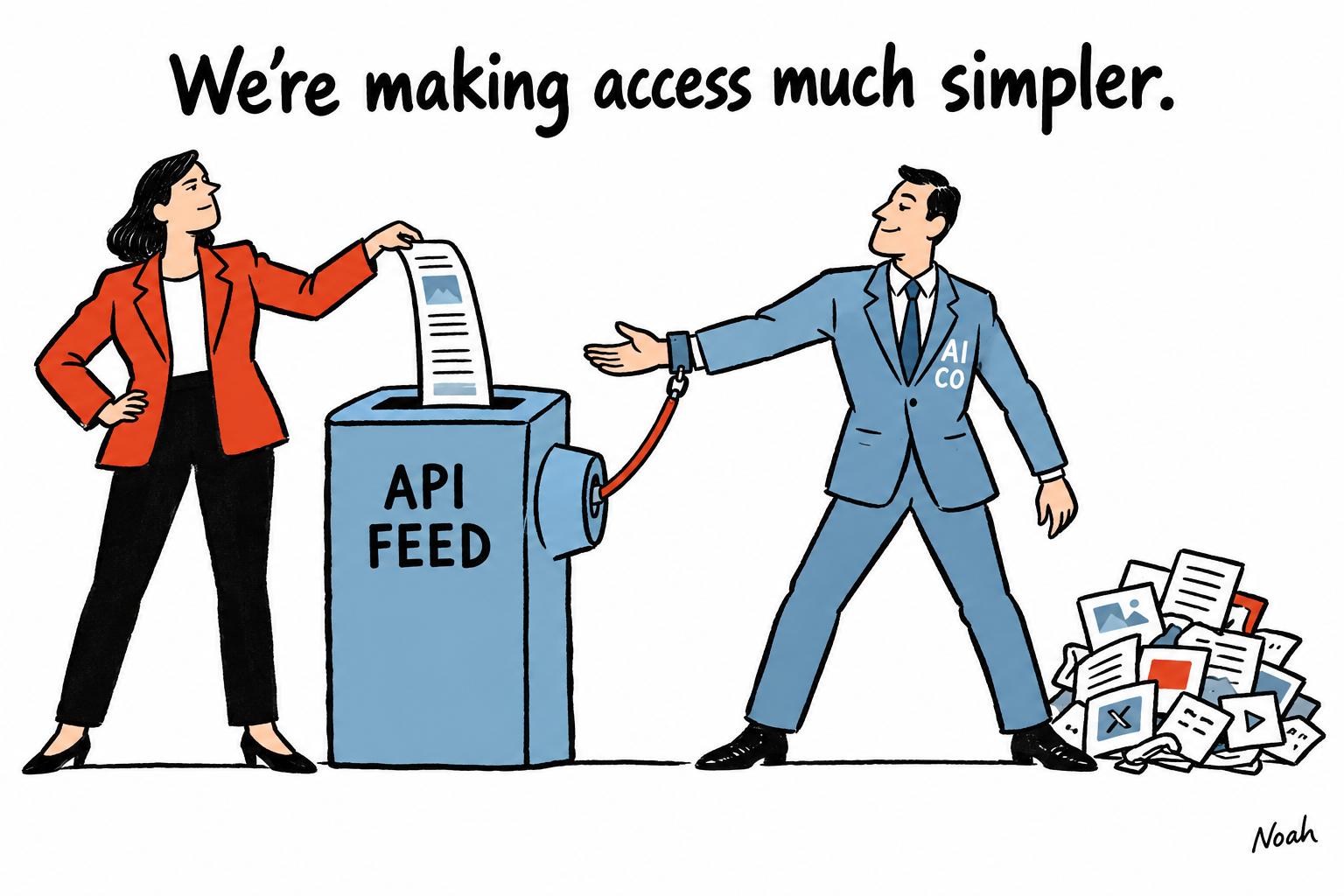
Custom APIs will deliver articles as structured text with trust markers, cutting webpage clutter and giving People Inc. greater control over how AI systems access its journalism.
People Inc. is recasting how its journalism is packaged for machines, moving towards custom application programming interfaces that deliver articles in a stripped-back format designed for AI agents rather than human browsers. According to chief innovation officer Jon Roberts, the goal is to give automated systems the text and the essential metadata they actually need, while removing the surrounding code and design layers that only make sense on a webpage. He told delegates at Digiday’s Media Strategies London event that an HTML page contains a great deal of material that an agent does not need, adding that processing all of it would be both distracting and unnecessarily costly.
The company’s approach marks the next step in a progression that has already taken in web crawling and then Amazon S3 buckets, which allowed People Inc. to send updates and retract content when needed. The new API model is intended to make access more efficient while also giving the publisher greater control over how its journalism is presented to AI partners. Roberts said the feeds will include article text in Markdown, plus information such as authorship, publication dates, update times and other trust markers that matter when content is consumed by automated systems.
The timing is significant. People Inc. recently laid off around 6% of its workforce, a move that underlines the pressure publishers are facing as AI reshapes how audiences find and consume news. The broader industry is also grappling with an explosion in machine-driven activity: HUMAN said in its 2026 State of AI Traffic and Cyberthreat Benchmark Report that traffic from AI agents and agentic browsers surged 7,851% year on year. That rise has sharpened concerns about how publishers distinguish between useful automated readers and bots simply scraping content.
At the same time, other media groups are pursuing their own experiments. Digiday has reported that Time is converting pages from HTML into Markdown and separating core text from design elements, while The Economist is testing more readable layouts for marketing and business-to-business material outside its paywall. Forbes, meanwhile, is trying similar methods for its product-review work, including Markdown versions and an MCP layer, although its executives have stressed that monetisation ideas such as ads for agents remain at an early stage.
For People Inc., the emphasis is not yet on advertising to AI agents, but on making sure its journalism is easier to discover, parse and trust in a world where automated systems are increasingly intermediary readers. That focus reflects a wider shift across publishing: rather than treating AI as a distant threat or a future opportunity, media companies are now redesigning parts of the web around it, one structured feed at a time.
Source Reference Map
Inspired by headline at: [1]
Sources by paragraph:
Source: Noah Wire Services
Noah Fact Check Pro
The draft above was created using the information available at the time the story first
emerged. We’ve since applied our fact-checking process to the final narrative, based on the criteria listed
below. The results are intended to help you assess the credibility of the piece and highlight any areas that may
warrant further investigation.
Freshness check
Score:
8
Notes:
✅ The supplied narrative closely follows a Digiday report by Jessica Davies published on 2 November 2026, the earliest substantially similar publication located in this search. No earlier version of this specific People Inc. API story was found. ⚠️ The broader theme is not new: Digiday had reported on related experiments by Time on 1 July 2026 and The Economist on 18 May 2026, both more than seven days earlier. Those are related industry precedents, not evidence that the People Inc. announcement itself is recycled. The article also includes earlier background, including layoffs reported in October 2025, and should not imply those cuts occurred recently without a precise date. Search results also show derivative summaries appearing on 2 November; they do not appear to predate Digiday.
Quotes check
Score:
7
Notes:
✅ The direct quotations attributed to Jon Roberts appear in the Digiday report published 2 November 2026, which is the earliest matching usage located. The supplied version paraphrases the principal quote about HTML content being distracting and costly rather than reproducing its full wording. ⚠️ The search did not independently locate a recording, transcript, or a separate contemporaneous account of Roberts's remarks at the event, so attribution and exact wording rely on Digiday. The article also paraphrases other remarks; those cannot be separately checked from the supplied text.
Source reliability
Score:
7
Notes:
✅ Digiday identifies the reporter, date, event and named company executive; the original report supports the central account and links its workforce-cut claim to Adweek. TheWrap independently reported in October 2025 that People Inc. cut 226 staff, or about 6% of its workforce. ⚠️ Digiday is a specialist media-industry publication, not a wire service or broad general-news outlet, and the central API development rests primarily on one executive's account at a Digiday event. The supplied article is a derivative rewrite of Digiday's reporting, not an independent investigation. The Human Security traffic figure is sourced to that company's own report, so it is an interested industry source rather than independent measurement.
Plausibility check
Score:
7
Notes:
✅ The custom-API, Markdown and metadata claims are consistent with the original Digiday report, and the cited Human Security report exists. The reported 7,851% rise is specifically attributed to HUMAN's 2026 benchmark report; it is not independently corroborated here and should be presented as that firm's estimate, not as an independently established industry-wide fact. ⚠️ The layoffs sentence is potentially misleading: TheWrap's linked report dates the roughly 6% reduction to 9 October 2025, whereas the Digiday report says 'last week' in relation to its November 2026 publication. That is a serious date inconsistency in the underlying source/article context and needs clarification before publication. The provided text also compresses and paraphrases the comparisons with Time, The Economist and Forbes; verify each detail against its linked report.
Overall assessment
Verdict (FAIL, OPEN, PASS): REVIEW
Confidence (LOW, MEDIUM, HIGH): MEDIUM
Summary:
⚠️ REVIEW is warranted chiefly because the layoffs claim appears chronologically inconsistent: the linked independent coverage dates People Inc.'s roughly 6% staff reduction to 9 October 2025, not the week before the Digiday report of 2 November 2026. Resolve that date before publication. ✅ The central API story is fresh relative to the earliest matching publication located, Digiday on 2 November 2026, and its named-source account is plausible. ⚠️ However, the article is a paraphrase of Digiday rather than independently reported work; the central claim lacks separate independent confirmation, the 7,851% traffic statistic comes from an interested corporate report, and the related publisher examples largely rely on Digiday's own earlier reporting. Digiday membership access is visible, but a hard paywall on this specific article was not confirmed. No distinctive opinion or creative content type was detected.