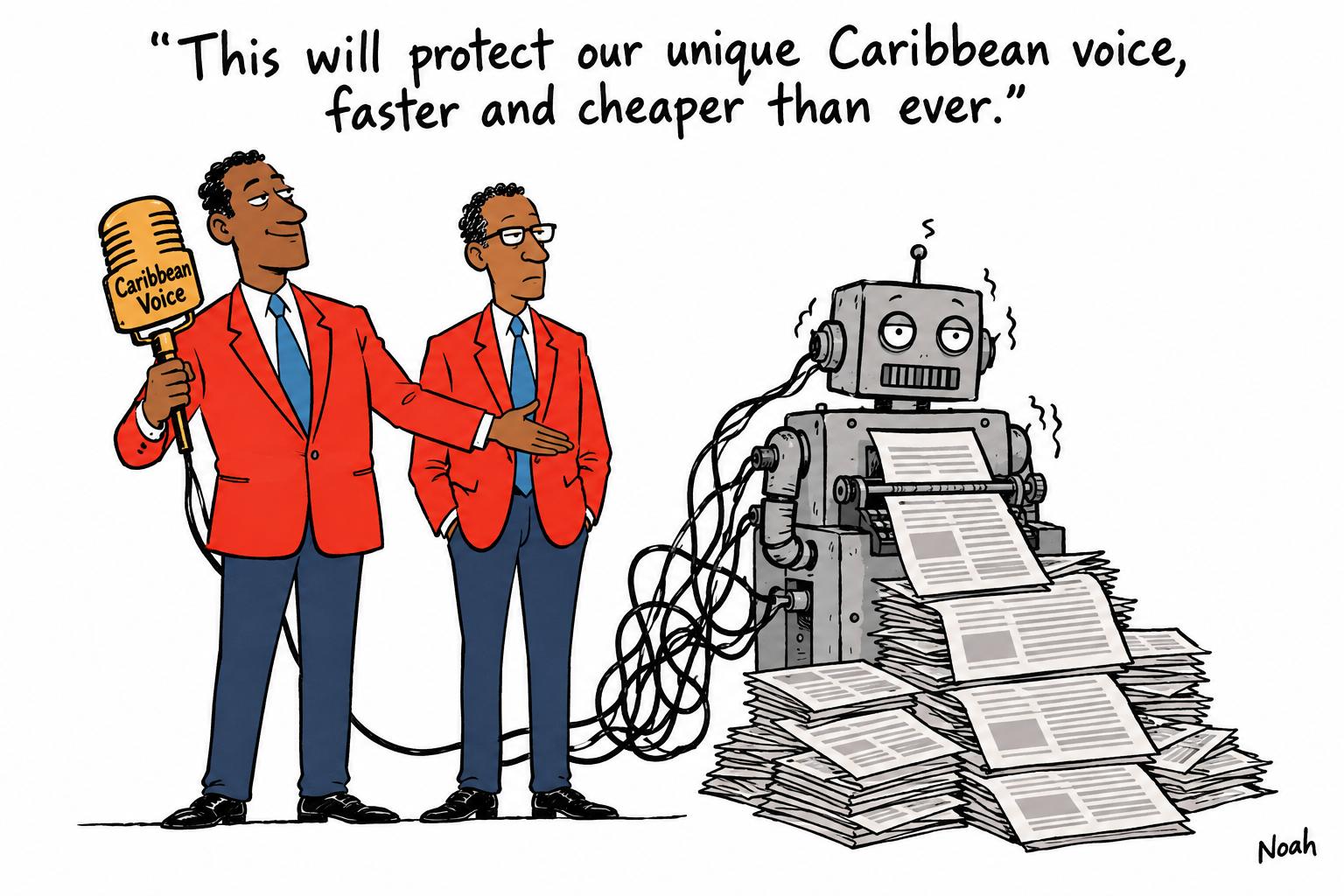
Artificial intelligence is already reshaping media operations across the Caribbean, and regional publishers are being forced to confront a difficult balance between innovation and survival. As AI tools become more capable of drafting copy, generating audio and producing convincing synthetic images, Caribbean news organisations face the prospect of greater efficiency at the same time as deeper threats to editorial independence, audience trust and the region’s distinctive voice.
The concerns are not merely theoretical. The Caribbean Broadcasting Corporation has highlighted the strain AI can place on small media markets, noting the risks of misinformation and the erosion of the Caribbean voice. The Media Institute of the Caribbean has similarly warned that, without proper guardrails, the technology could weaken the financial sustainability of already fragile outlets that operate with limited advertising income and narrow margins.
UNESCO has also urged a broader response to the shifting information environment. In discussions with Caribbean journalists about press freedom in the digital age, the organisation has stressed that reporting remains essential in a media landscape increasingly shaped by automated systems. That warning reflects a wider international anxiety: AI can make publishing faster and cheaper, but it can also amplify falsehoods, blur authorship and reduce the incentive to fund original reporting.
A central worry for the region is that the large datasets used to train mainstream AI systems often fail to reflect Caribbean realities. Local dialects, cultural references, political histories and social nuances can be flattened or misunderstood when imported technology is applied without careful adaptation. The result, critics say, is not simply poorer language, but a subtle form of homogenisation that could weaken the particular identity of Caribbean journalism.
The economic impact may prove just as severe. Caribbean AI Signals, a study examining the region’s AI discourse in the first half of 2026, found a sharp divide between the upbeat tone used by ministries and the anxiety felt by workers. Its dominant fear cluster centred on job losses in services, business process outsourcing and administrative roles, underscoring how AI debates in the Caribbean are increasingly tied to questions of employment, productivity and social stability. The same pressures are visible in media, where automated content can be attractive to under-resourced newsrooms but also threaten the human labour on which journalism depends.
International bodies have framed the issue in terms of democratic resilience as well as commercial viability. The United Nations has warned that AI-driven systems can be weaponised to distort reality, spread targeted disinformation and deepen mistrust in public institutions. At the same time, regional and global advocates have argued that the business model of news is itself under pressure, as automated content and algorithmic advertising can divert attention and revenue away from credible outlets while flooding the information space with low-cost material.
That concern has fed into calls for stronger regional coordination. CARICOM has argued that digital transformation should not proceed in a regulatory vacuum, particularly for small island developing states that are often left out of the global policy conversation. The Caribbean Broadcasting Union has taken a similarly practical line, encouraging broadcasters to learn the technology rather than retreat from it. Under president Anthony Greene, the union has pushed AI literacy, disclosure rules and verification frameworks, alongside training resources intended to help member organisations use the tools responsibly while preserving editorial judgement.
For Caribbean media, the challenge now is to adopt AI without surrendering the human values that give journalism its authority. That means tighter standards on source protection, clearer rules on synthetic content and greater investment in local data that reflects Caribbean speech and experience. It also means recognising that while AI can support research, transcription and workflow efficiency, it cannot replace the judgement, empathy and cultural understanding required to report credibly on the region. The question is not whether AI will enter Caribbean newsrooms, but whether the region can shape its use before outside systems define the stories it tells about itself.
Source Reference Map
Inspired by headline at: [1]
Sources by paragraph:
- Paragraph 1: [2], [6]
- Paragraph 2: [2], [5]
- Paragraph 3: [3]
- Paragraph 4: [1]
- Paragraph 5: [4], [5], [6]
- Paragraph 6: [1], [3], [5]
- Paragraph 7: [1], [2], [3], [4], [5]
Source: Noah Wire Services