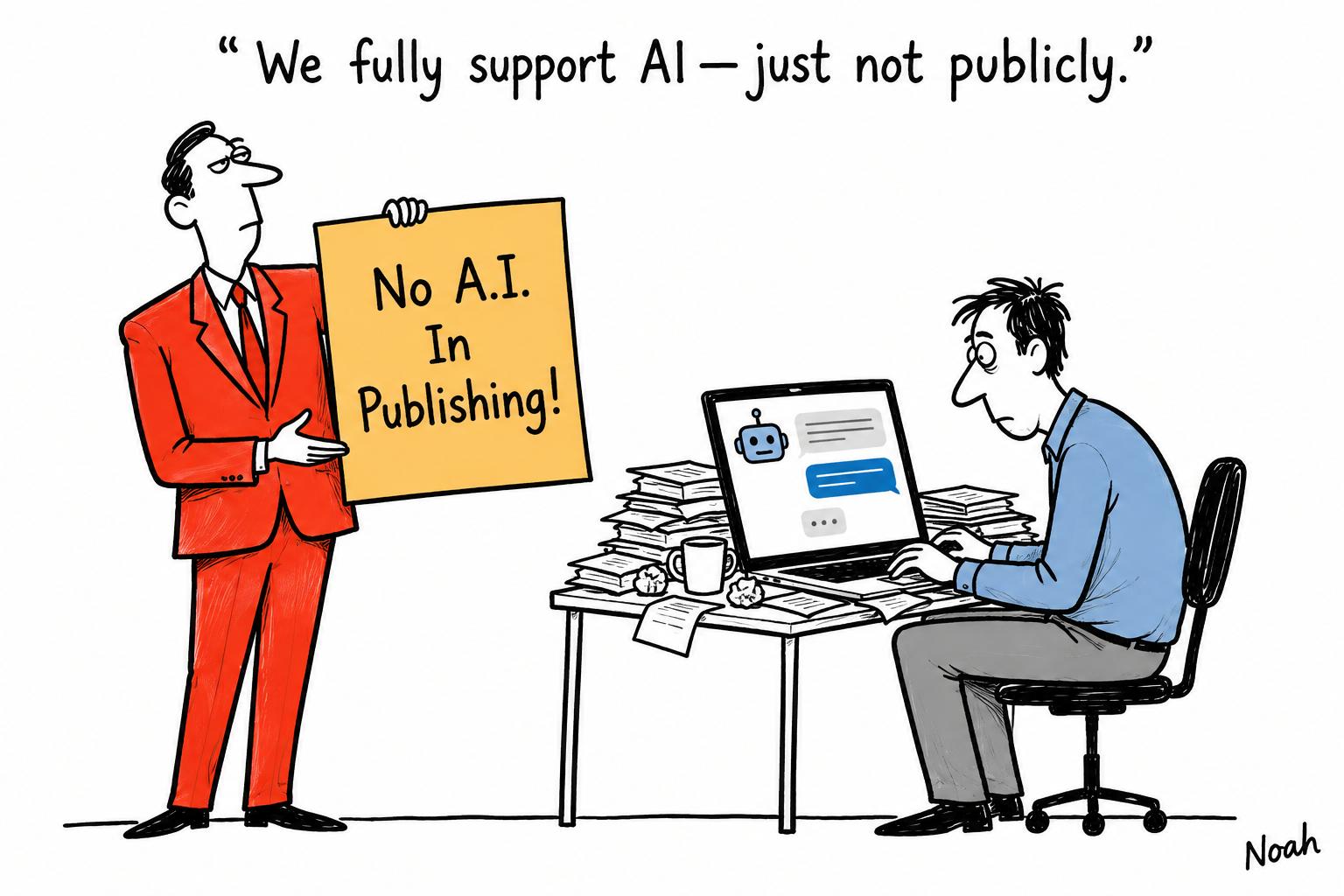
Employees at major US publishers say managers are promoting ChatGPT and Claude for everyday work, exposing a widening gap between the industry’s public resistance to AI and its internal adoption.
Employees at some of the largest US book publishers are said to be using generative artificial intelligence in ordinary business tasks even as the industry continues to warn publicly about the technology’s dangers. According to WIRED, staff at HarperCollins, Simon & Schuster and Hachette have described managers promoting tools such as Claude and ChatGPT for publicity copy, back-cover text, cover concepts, marketing material and routine emails, creating a sharp contrast between public caution and internal practice.
The accounts suggest that the push has often come from the top. WIRED reported that some workers were asked to help normalise AI use and to identify practical applications for it, with one HarperCollins employee saying senior leaders had bought Claude licences and then struggled to work out how best to use them. The publication added that staff were encouraged to attend repeated brainstorming sessions to find further uses across the business, while some younger employees felt the burden of proving the technology’s value was being placed on them.
That internal encouragement has reportedly met resistance. Employees told WIRED that concerns about legal, ethical and environmental risks were brushed aside in one discussion as simply "the cost of doing business". HarperCollins later updated its internal guidance to acknowledge that artificial intelligence has an environmental impact, although it said this represented only a small share of most people’s overall digital carbon footprint. The tension has been particularly acute in an industry where, according to WIRED’s citation of 2023 data, the average starting salary for publishing workers at the Big Five and Scholastic in New York City was $47,583.
The broader backdrop is an industry publicly fighting AI while quietly experimenting with it. WIRED reported that publishers have spent much of the year opposing generative AI through copyright disputes and by removing books suspected of relying on large language models, yet employees say those headline cases may capture only part of the picture. Some staff told the magazine that books were being withdrawn over AI concerns without public explanation, deepening unease about disclosure, author consent and the possibility that the drive for efficiency is outpacing the sector’s willingness to confront the creative and labour consequences.
Source Reference Map
Inspired by headline at: [1]
Sources by paragraph:
Source: Noah Wire Services
Noah Fact Check Pro
The draft above was created using the information available at the time the story first
emerged. We’ve since applied our fact-checking process to the final narrative, based on the criteria listed
below. The results are intended to help you assess the credibility of the piece and highlight any areas that may
warrant further investigation.
Freshness check
Score:
10
Notes:
The article is based on a recent WIRED report dated October 9, 2026, detailing the internal use of AI tools by major US book publishers. No earlier versions or recycled content were identified, confirming the freshness of the information. ([newsminimalist.com](https://www.newsminimalist.com/articles/publishers-use-ai-quietly-staff-push-back-at-harpercollins-simon-and-schuster-hachette-c5bb4c0c?utm_source=openai))
Quotes check
Score:
8
Notes:
The article includes direct quotes attributed to anonymous employees and company representatives. While the quotes are consistent with the WIRED report, their anonymity and lack of independent verification raise concerns about their authenticity. ([newsminimalist.com](https://www.newsminimalist.com/articles/publishers-use-ai-quietly-staff-push-back-at-harpercollins-simon-and-schuster-hachette-c5bb4c0c?utm_source=openai))
Source reliability
Score:
7
Notes:
The primary source is WIRED, a reputable publication. However, the article relies on secondary sources that may not be as reliable, and the use of anonymous sources without independent verification diminishes the overall reliability. ([newsminimalist.com](https://www.newsminimalist.com/articles/publishers-use-ai-quietly-staff-push-back-at-harpercollins-simon-and-schuster-hachette-c5bb4c0c?utm_source=openai))
Plausibility check
Score:
6
Notes:
The claims about publishers using AI tools internally align with industry trends. However, the lack of independent verification and reliance on anonymous sources introduce uncertainties about the accuracy of these claims. ([newsminimalist.com](https://www.newsminimalist.com/articles/publishers-use-ai-quietly-staff-push-back-at-harpercollins-simon-and-schuster-hachette-c5bb4c0c?utm_source=openai))
Overall assessment
Verdict (FAIL, OPEN, PASS): REVIEW
Confidence (LOW, MEDIUM, HIGH): MEDIUM
Summary:
The article presents claims about major US book publishers using AI tools internally, based on a recent WIRED report. However, the reliance on secondary sources, anonymous accounts, and the lack of independent verification introduce uncertainties about the accuracy and reliability of the information. Further editorial review and independent verification are recommended before publishing.