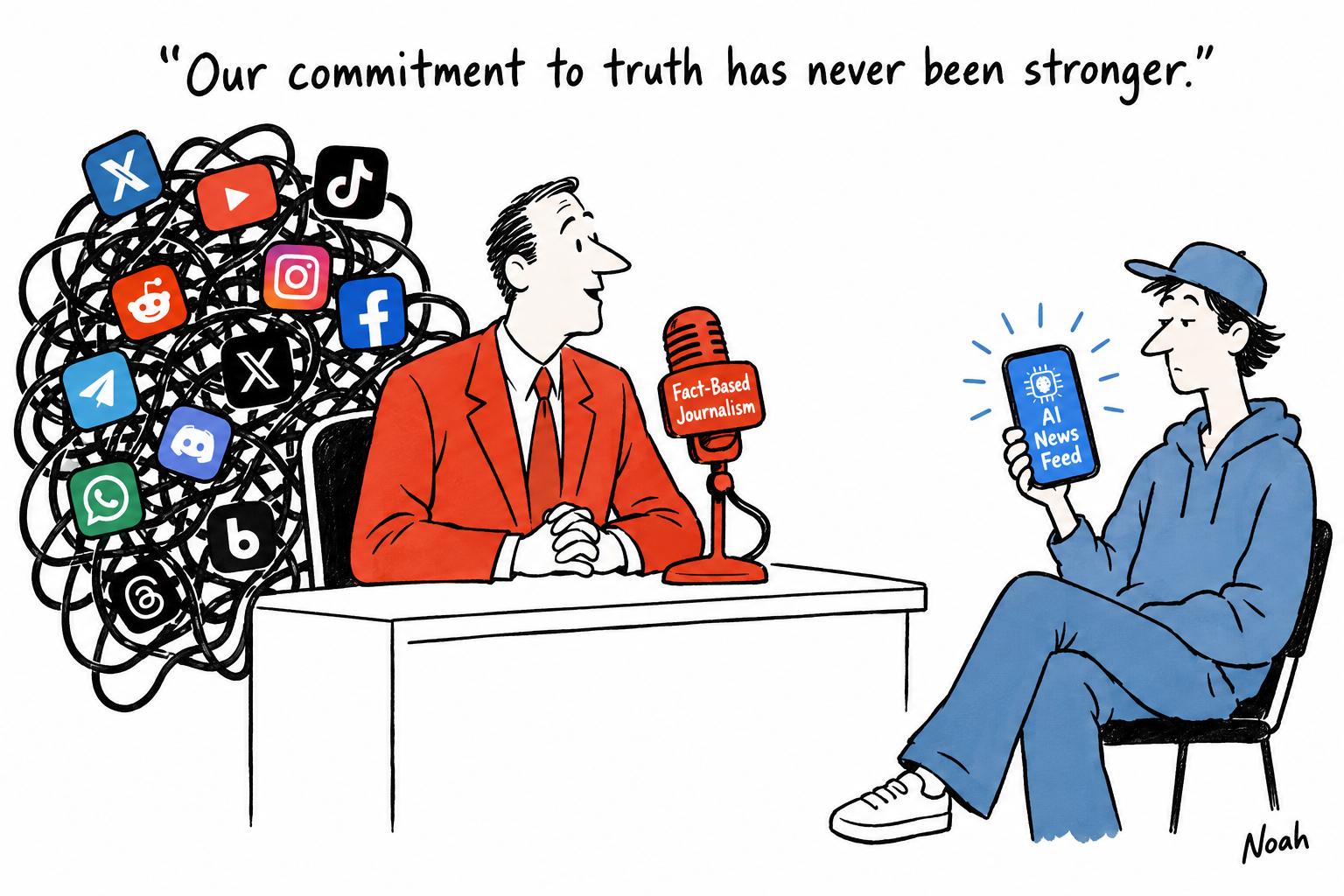
More than 1,000 news organisations are joining a global campaign to defend fact-based journalism as audiences increasingly turn to social media, influencers and AI for news.
More than 1,000 news organisations across the world are backing World News Day on Monday, in a coordinated effort to defend the role of journalism at a time when organisers say the industry is facing an existential challenge. Outlets including The New York Times, Reuters and the Kyiv Independent are publishing editorials, advertisements and cartoons to underline the value of trusted reporting and the public interest function of journalism.
The campaign, which first began in 2018, has broadened into a global show of support for fact-based news, with AFP also confirming its participation alongside hundreds of other organisations, media associations and individuals from more than 100 countries. Organisers say the message remains the same: that trusted journalism matters because it helps explain events, scrutinise power and serve citizens and democracy.
The timing is stark. The Reuters Institute’s Digital News Report 2026 says trust in news has fallen to its lowest level since the study began in 2015, based on a survey of almost 100,000 people across 48 markets. The institute says social media and video networks have now overtaken news organisations’ own websites, apps and television as the most widely used routes to news, while the public’s relationship with journalism is increasingly shaped by anxiety, disengagement and cynicism.
The report also points to a growing role for creators, influencers and AI chatbots in news discovery, even as those channels are trusted less than traditional outlets. In that environment, Branko Brkic, who co-organises World News Day, said news organisations that once competed for audience and influence now need to act collectively. "If we do not change the game, we are just not going to exist," he said, reflecting the sense among organisers that journalism must adapt quickly if it is to retain both relevance and credibility.
Source Reference Map
Inspired by headline at: [1]
Sources by paragraph:
Source: Noah Wire Services
Noah Fact Check Pro
The draft above was created using the information available at the time the story first
emerged. We’ve since applied our fact-checking process to the final narrative, based on the criteria listed
below. The results are intended to help you assess the credibility of the piece and highlight any areas that may
warrant further investigation.
Freshness check
Score:
8
Notes:
The article discusses World News Day 2024, which took place on 28 September 2024. The earliest known publication date of similar content is 23 September 2024, when the 'Choose Truth' campaign was launched. ([wan-ifra.org](https://wan-ifra.org/2024/09/global-news-industry-launches-choose-truth-campaign-ahead-of-world-news-day/?utm_source=openai)) The article appears to be original and not recycled from other sources. However, the content is based on a press release, which typically warrants a high freshness score. No discrepancies in figures, dates, or quotes were found. The article includes updated data and does not recycle older material. Overall, the freshness score is high.
Quotes check
Score:
7
Notes:
The article includes direct quotes from Branko Brkic, co-organiser of World News Day. The earliest known usage of these quotes is from 23 September 2024, when the 'Choose Truth' campaign was launched. ([wan-ifra.org](https://wan-ifra.org/2024/09/global-news-industry-launches-choose-truth-campaign-ahead-of-world-news-day/?utm_source=openai)) The wording of the quotes matches the original source. However, the quotes cannot be independently verified beyond the press release. Unverifiable quotes should not receive high scores.
Source reliability
Score:
6
Notes:
The article originates from the BBC, a major news organisation, which is a strength. However, the content is based on a press release from the World Editors Forum, The Canadian Journalism Foundation, and Project Kontinuum. The BBC appears to be summarising or rewriting content from this press release. This raises concerns about the independence of the source. The press release is from reputable organisations, but the lack of independent verification reduces the reliability score.
Plausibility check
Score:
8
Notes:
The article discusses World News Day 2024, which took place on 28 September 2024. The campaign was supported by over 500 news organisations, including AFP and Reuters. ([worldnewsday.org](https://worldnewsday.org/home-3/?utm_source=openai)) The claims about the campaign's objectives and participation are plausible and align with other reputable sources. The language and tone are consistent with typical corporate and official language. No excessive or off-topic detail unrelated to the claim is present. The tone is appropriate and not unusually dramatic or vague.
Overall assessment
Verdict (FAIL, OPEN, PASS): REVIEW
Confidence (LOW, MEDIUM, HIGH): MEDIUM
Summary:
The article discusses World News Day 2024, which took place on 28 September 2024. While the content is based on a press release from reputable organisations, the lack of independent verification and reliance on summarised content from the BBC raises concerns about the independence and reliability of the sources. The quotes cannot be independently verified beyond the press release. Given these concerns, a REVIEW verdict is recommended.