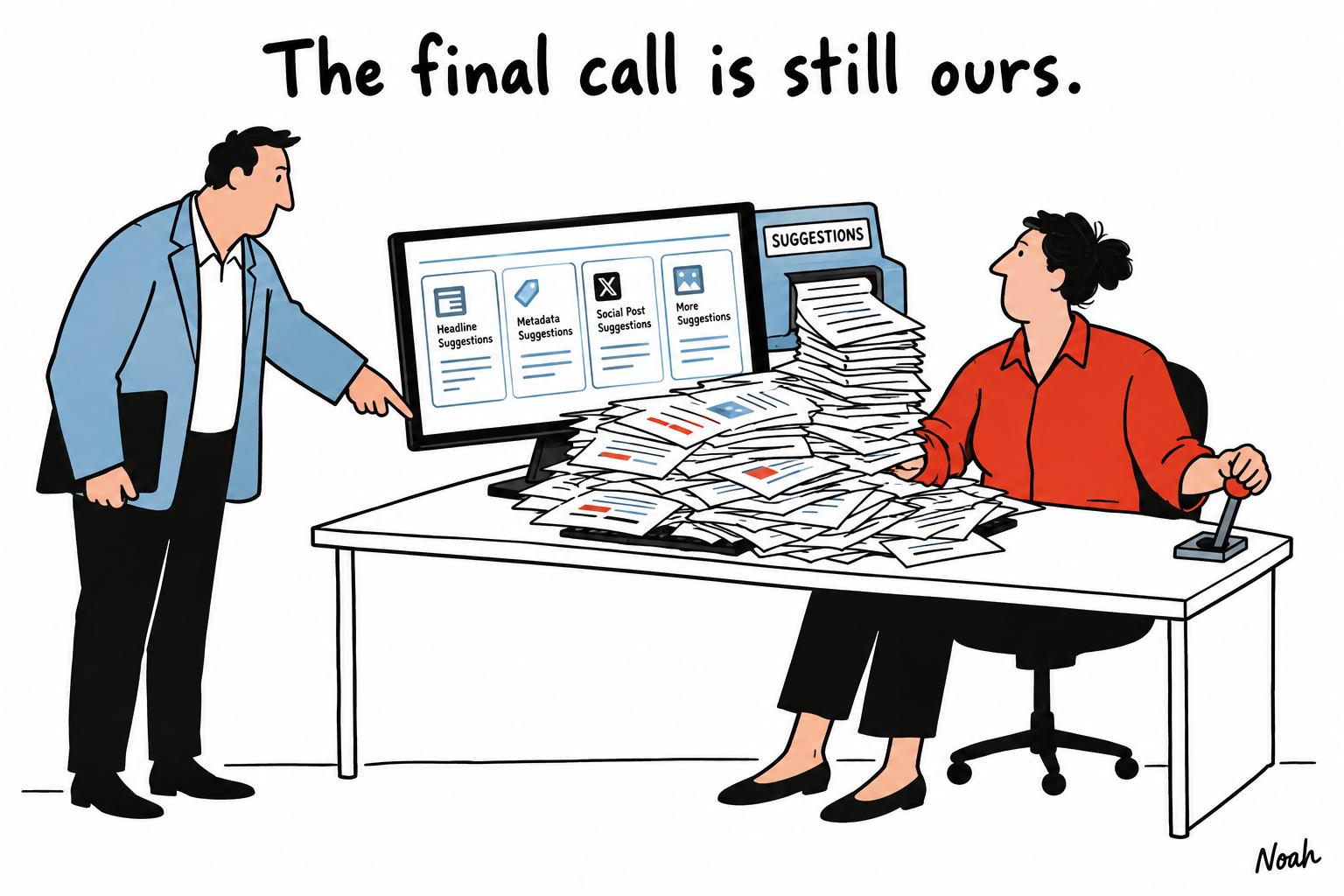
The publishing workflow extends well beyond drafting: editors also prepare metadata, select imagery and adapt copy for several social platforms. Qubika says it built an AI-assisted suite for a digital publisher to reduce that workload, placing suggested material inside the editor’s existing writing environment. The publisher’s staff retain control of the final review and publication decision.
The application runs on Databricks, with a Next.js interface connected to a FastAPI service. Qubika says its Claude-based agents can propose titles, summaries, descriptions, tags, links and image choices, as well as edits to style and grammar. To draw on the publisher’s existing material, the system retrieves relevant examples from its archive using Databricks Vector Search, now described in the platform’s documentation as AI Search. Databricks says the service can search indexed content using semantic similarity, keyword matching or a combination of the two, with indexes governed through Unity Catalog.
The wider architecture brings together application hosting, data processing and model management. Qubika describes using Databricks Apps for the interface and API, Lakeflow pipelines and Delta Lake to organise editorial material and quality metrics, and Lakebase for operational data. Databricks’ documentation says Apps can host data and AI applications on its serverless platform and connect with services such as Unity Catalog. Its Lakeflow guidance describes tools for building batch and streaming data pipelines. These platform capabilities provide context for the design, but the project’s specific implementation and results are reported by Qubika.
For branded social images, Qubika says it developed a rendering service intended to produce exactly matching output whenever it receives the same input. The company reports testing image changes against reference renders, an approach designed to catch unintended visual differences. That emphasis on repeatability accompanies a separate quality process for prompts: each proposed version is tested against the one currently in use and is only advanced if it meets a non-inferiority threshold. Databricks’ Prompt Registry documentation supports version tracking, access controls and audit trails, while the evaluation threshold itself is a project-level policy.
The publisher’s editors continue to set the standards for brand voice and approve generated suggestions. Qubika says the metadata feature is in production and that social-copy generation has passed its end-to-end tests. It also reports around 2,000 tests across the codebase, with about 87 per cent of model-call traffic attributed to the content or feature involved. The company says this gives the publisher a view of AI usage costs, while acknowledging that exact attribution depends on adding a unique identifier to each gateway request.
Databricks’ model-serving documentation describes scale-to-zero as an option for reducing compute use when an endpoint is idle, but notes that restarting it can introduce a cold start and that capacity is not assured while it is scaled down. That trade-off matters for a live editorial tool, where lower idle costs may come at the expense of response times or predictable availability. Qubika says its system uses scale-to-zero endpoints; the platform guidance makes clear that the suitability of this setting depends on operational requirements.
Qubika’s broader lesson is that AI assistance is more useful when it fits an established workflow and leaves publishing authority with people. Its account also stresses treating prompts as controlled changes, testing generated images for consistency and capturing request identifiers from the outset to improve cost attribution. The same pattern, the company suggests, could suit other organisations producing large volumes of brand-sensitive material that must pass human review.
Source Reference Map
Inspired by headline at: [1]
Sources by paragraph:
- Paragraph 1: [2]
- Paragraph 2: [2], [4]
- Paragraph 3: [2], [3], [7]
- Paragraph 4: [2], [5]
- Paragraph 5: [2]
- Paragraph 6: [2], [6]
- Paragraph 7: [2]
Source: Noah Wire Services