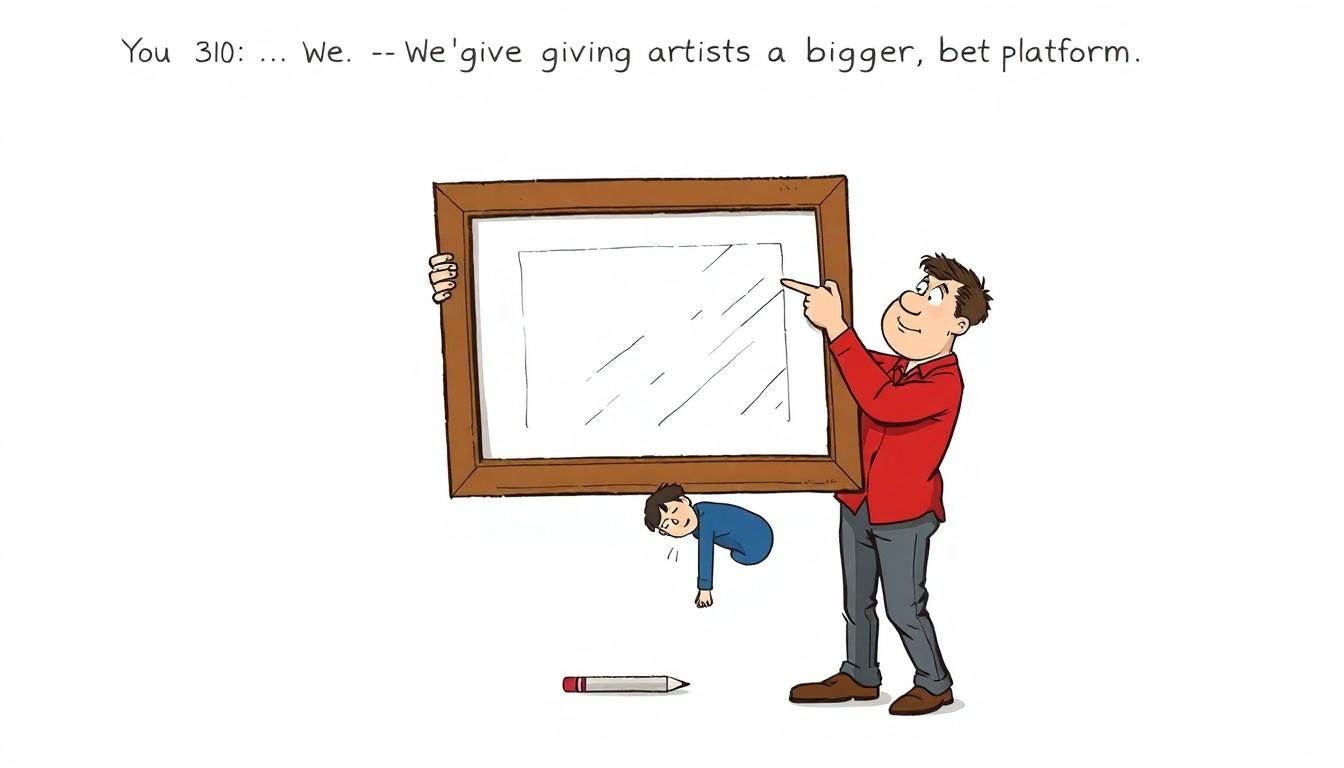
The Baltimore Sun’s use of AI-generated images in place of editorial cartoons has prompted a wider argument about who creates journalism, how that work is credited and what readers lose when newsrooms automate creative tasks.
The paper began publishing the images after dismissing its longtime cartoonist, Kevin “KAL” Kallaugher, a two-time Pulitzer Prize finalist. The Sun initially ran syndicated cartoons before introducing generated illustrations on its opinion pages. In one example, the image’s own caption disclosed that it had been made using AI tools by the newspaper’s editorial staff. That disclosure made the production method clear, but did little to settle the dispute over whether the resulting work belonged in a space traditionally associated with an individual artist’s judgement and craft.
The Association of American Editorial Cartoonists condemned the Sun’s decision in an open letter, arguing that replacing a human cartoonist with generated imagery diminishes the work of artists and weakens journalism. The organisation also invoked the paper’s history of publishing KAL, whom it described as an internationally acclaimed cartoonist, and urged editors to reject AI for cartoons and other creative content. The letter represents the association’s advocacy position, rather than an independent account of how the Sun made its decision.
KAL told Baltimore Fishbowl that the repeated appearance of generated images made the practice seem like an ongoing editorial policy, not an isolated experiment. He described it as a case of AI taking people’s jobs, while distinguishing between using technology to gather visual references and asking an image generator to produce the finished work. In a field where visual choices and caricature are central to the argument, the difference between assistance and substitution is particularly visible.
The criticism is not confined to the cartoonists’ professional association. FAIR’s account describes the Sun’s images as relying on generic figures and explanatory text rather than visual wit or concise satire. The dispute, then, is not simply about whether an image has been labelled as AI-generated. It is also about whether automated illustrations can offer readers the interpretation and originality expected of editorial cartooning, and whether a newspaper should present them as a replacement for a named human artist.
Questions of attribution have become sharper as image generators have produced cartoons carrying signatures associated with real New Yorker contributors. Nieman Journalism Lab reported on examples bearing artists’ names, including work that the cartoonists said they had neither made nor endorsed. A signature can imply authorship and approval, so its appearance raises concerns about reputation and identity as well as possible legal claims. The report cautions, however, that imitation of an artist’s style does not by itself establish copyright infringement; the legal position may depend on the circumstances, including how an image is used.
The concerns sit within a broader debate about AI and the conditions under which creative work is used. A report by Cartooning for Peace recommends stronger ways to identify and trace cartoons, greater transparency about the material used to train image generators, and an explicit opt-in approach to including copyrighted work in training databases. It also calls for mechanisms to address economic or moral harm caused by unauthorised use. These are policy proposals, not evidence that every risk has already materialised in every newsroom, but they highlight the unresolved questions facing artists and publishers.
The pressure extends beyond illustration. FAIR’s account cites AI-written or AI-assisted material across opinion writing and news production, including the Financial Times’ apology after an undisclosed AI process was used to condense a column. Columbia Journalism Review has separately documented newsroom cuts at McClatchy and journalists’ concerns about the company’s use of automation. It reported that more than 90 unionised media workers across 17 publications were laid off in September 2026, while noting that a direct link between those cuts and AI plans had not been established. Journalists told the review that AI was being used for some repackaging and content-production tasks, amid uncertainty about future policy and the effect of staff losses on coverage.
That distinction matters. Automation may be used to support reporting or production, but uncertainty about its role can leave staff unsure how their work is being handled and readers unclear about who, or what, produced what they see. For cartoonists, the Sun dispute makes the consequences concrete: generated images can occupy space once filled by a human artist, while signatures and styles can be reproduced in ways that risk misleading audiences about authorship.
The immediate controversy is about editorial cartoons, but the underlying question is wider: whether publishers will treat AI as a disclosed tool that supports journalism, or as a substitute for the people whose judgement, experience and creativity give it value. The professional and policy responses call for transparency and protection for artists; the challenge for news organisations is to show readers where automation is used without obscuring who is responsible for the work.
Source Reference Map
Inspired by headline at: [1]
Sources by paragraph:
- Paragraph 1: [2], [3]
- Paragraph 2: [2]
- Paragraph 3: [3]
- Paragraph 4: [4]
- Paragraph 5: [2], [3]
- Paragraph 6: [5]
- Paragraph 7: [6]
- Paragraph 8: [2], [7]
- Paragraph 9: [5], [7]
- Paragraph 10: [3], [6]
Source: Noah Wire Services