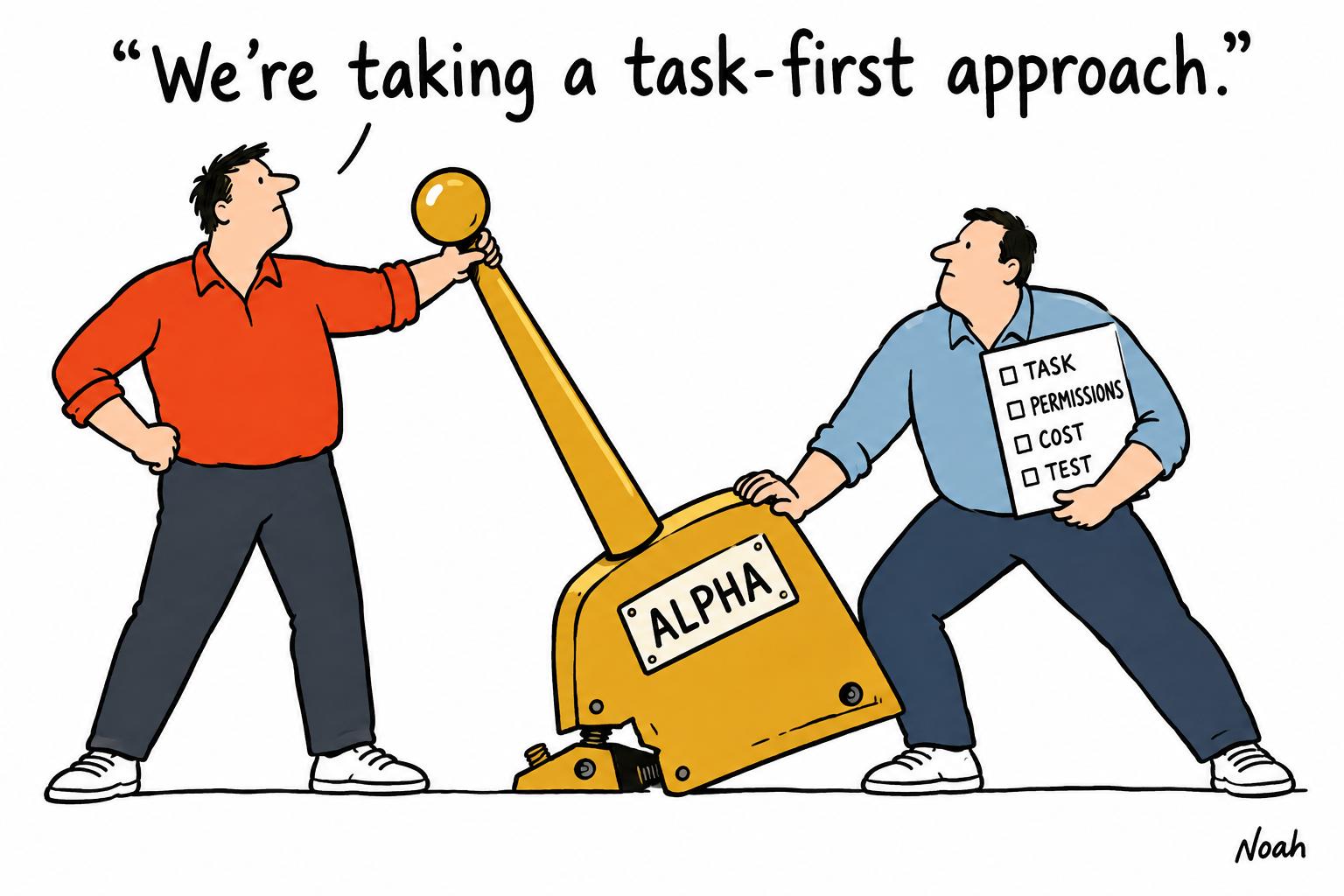
Selecting Drupal AI components is less a question of assembling the largest possible toolkit than of identifying a specific task and deciding how much automation it warrants. A prompt that gives an editor a draft to review carries different risks from an integration that lets an outside agent alter site content. Semantic search brings its own technical and financial demands.
A useful starting point is to separate the shared framework from the modules that deliver particular features. The Drupal AI project provides common foundations for connecting the CMS to providers, but individual workflows may require additional modules and configuration. The project’s release page is the place to check the requirements and security coverage of the precise version under consideration; a stable framework release does not, by itself, establish that every component in a proposed stack will work together.
The Drupal AI Initiative describes the distinction between bringing AI into Drupal for people using the CMS and enabling external software to interact with Drupal. The first model includes editorial support, where a person can assess an output before acting on it. The second may expose capabilities to agents operating outside the site, making authentication, permissions and limits on what those agents can do central design questions. The initiative’s description sets out a direction, not a guarantee that every proposed capability is already available as a stable release.
For editorial teams, AI Content Suggestions offers assistance in the editing interface, with the editor deciding whether to use what it generates. Its project page lists a stable release alongside an alpha version and distinguishes this in-the-moment support from AI Content Review. Review is designed for configurable checks and saved results, but its listed release is alpha, so teams should assess it as prerelease software rather than infer production readiness from its feature set. In either case, generated recommendations need to be tested against the site’s content and editorial standards.
More extensive automation can save time on repeated tasks, but it also gives errors and provider costs more opportunities to accumulate. A bounded workflow should specify which content is eligible, when processing runs and how failures are handled. Before applying it at scale, teams need to test the complete module and provider combination and establish whether retries or repeated triggers could create duplicate work. The Drupal AI framework’s requirements should be checked alongside those of every feature module in the installation.
Semantic search requires evaluation of the whole retrieval process, not just the model call. Drupal’s AI Search project connects embeddings with Search API, but its listed releases are alpha and it has no supported stable release in the snapshot described here. Teams must account for preparing content, generating and storing embeddings, maintaining indexes and, where answers are generated, sending retrieved material to a model. They should also test whether ordinary search already meets users’ needs and verify that restricted content cannot enter a model’s context through retrieval.
AI Translate supports translation workflows for Drupal content, but its project history illustrates why package boundaries matter: it became a separate project from AI 1.4.0 onwards. The project identifies its 2.0 development line as pre-alpha, distinct from the 1.4 release series. Translation drafts still need language review, terminology guidance and an approval process. Tracking the source revision behind each draft can help teams identify which translations may need attention after the original content changes.
For teams considering a first deployment, a narrowly scoped editorial pilot is generally easier to assess than an agent with the ability to make changes. Check the exact release requirements, permissions, provider operations and handling of sensitive material; then test failures, retries and representative workloads. Measure usage as well as output quality, since multiple review criteria, languages or agent steps can each generate additional requests. A module’s published status is one input to that decision, not a substitute for testing the complete site-specific configuration.
The October 2026 snapshot is a guide to release listings as checked on 13 October, not a compatibility certification. The Drupal AI project notes that requirements and release details can change, while the AI Search and AI Content Review listings demonstrate that prominent capabilities may still be prerelease. Teams should consult the relevant project pages before implementation and reassess their dependencies and workflow as releases evolve.
Source Reference Map
Inspired by headline at: [1]
Sources by paragraph:
- Paragraph 1: [7]
- Paragraph 2: [2]
- Paragraph 3: [7]
- Paragraph 4: [3], [4]
- Paragraph 5: [2]
- Paragraph 6: [5]
- Paragraph 7: [6]
- Paragraph 8: [2], [3], [4], [5]
Source: Noah Wire Services