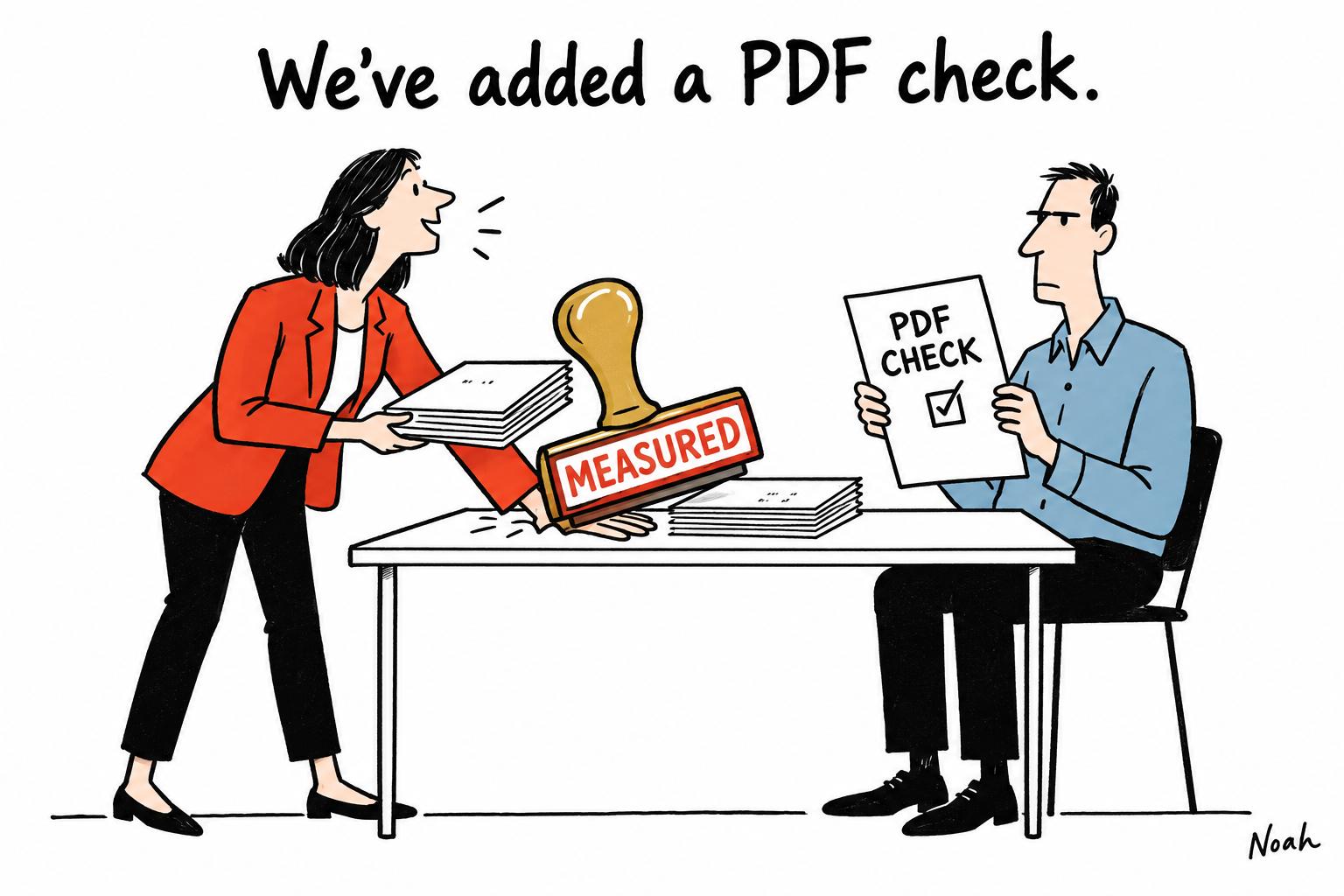
Flashpapers found errors in explainers for Cross-Teacher Guarding and LatentLoop, including estimated compute savings presented as measured results. The company has added PDF checks and human approval.
Flashpapers, an AI-driven site that turns arXiv papers into interactive explainers, says its own experiment with three recent research papers exposed how easily a polished summary can drift away from the source text. In October, the publisher generated explainers for LatentLoop, Cross-Teacher Guarding, and Cortex, then checked each number, table reference and claim against the underlying PDFs before publication. According to the company, two of the explainers contained material that the papers themselves did not support, despite the pages looking authoritative to readers.
The most serious problems appeared in the Cross-Teacher explainer. Flashpapers says the page attributed results to a 1.7-billion-parameter model in settings where the paper only reported figures for the 4-billion-parameter version, then framed those numbers as evidence of consistent gains across model sizes. It also attached conflict-rate statistics to the wrong figure and described an additional scoring step as though it introduced no extra work at test time, even though the paper places that cost in training. The underlying paper is about Cross-Teacher Guarding, a method designed to reduce interference between multiple teachers by using cross-domain critics, agreement-based feedback and gradient projection.
LatentLoop had a different kind of error. The paper studies asymmetric compute allocation in looped mixture-of-experts systems and reports improved validation loss across fifteen configurations, but the savings headline is not a direct measurement: it comes from a fitted scaling-law estimate. Flashpapers says its explainer incorrectly presented that estimate as empirical and transformed a comparison of GPU hours into a claim of wall-clock speed-up. The paper’s own abstract makes clear that the 19.0 per cent compute saving is a prediction from the fit, not a measured runtime result.
The Cortex explainer, by contrast, was not singled out for invented numbers in the same way, but it still sat within the broader problem Flashpapers is warning about: generated summaries can sound precise while quietly overstating what a paper has actually shown. Cortex focuses on preserving the gains an LLM gets from context after that context is removed, using prospective query generation and distillation into low-rank or structural updates. The paper reports results across five task families and models from 4 billion to 120 billion parameters, including a sequential-edit experiment in which Cortex-Structural recovers most of the context-induced gain while retaining nearly all of the original non-target performance.
Flashpapers says the good news is that the headline numbers, formulas, most tables and author details were largely correct; the mistakes clustered in the very features readers are most likely to trust, such as interactive widgets and takeaway boxes. That concern is backed by broader research showing that multimodal systems often struggle more with charts than tables, and by work suggesting that domain-specific fine-tuning does not guarantee factual reliability. Flashpapers says it has now corrected the pages, added PDF checks for seeded explainers and introduced human approval before publication, a modest but telling reminder that fluent machine-written research summaries still need the same kind of verification as any other technical reporting.
Source Reference Map
Inspired by headline at: [1]
Sources by paragraph:
Source: Noah Wire Services
Noah Fact Check Pro
The draft above was created using the information available at the time the story first
emerged. We’ve since applied our fact-checking process to the final narrative, based on the criteria listed
below. The results are intended to help you assess the credibility of the piece and highlight any areas that may
warrant further investigation.
Freshness check
Score:
8
Notes:
🕰️ The specific account of Flashpapers checking its three explainers appears to have been published on DEV on 2 November 2026, and searches found no substantially similar earlier report of that audit. The underlying papers are older: arXiv records LatentLoop and Cortex as submitted on 14 October 2026, and Cross-Teacher Guarding on 9 October 2026. Those papers are background, not evidence that the audit itself is recycled. The DEV post is the earliest located publication of the audit narrative; search results are not exhaustive, so originality cannot be guaranteed. ([dev.to](https://dev.to/flashpapers/we-checked-three-llm-written-paper-explainers-against-the-pdfs-two-had-numbers-the-papers-never-233h))
Quotes check
Score:
5
Notes:
⚠️ The supplied article contains no attributable interview quotations; its quoted phrases are presented as labels or wording from the Flashpapers explainer, such as “zero extra rollouts at test time”. The DEV post contains matching wording and details, but it is the account being summarised, not independent corroboration. The underlying arXiv records support several technical distinctions, including that LatentLoop’s 19.0% saving is predicted from a fitted NLL and that Cross-Teacher Guarding uses auxiliary teachers. No independent source was located verifying what Flashpapers’ original widgets said or independently confirming its audit findings. ([dev.to](https://dev.to/flashpapers/we-checked-three-llm-written-paper-explainers-against-the-pdfs-two-had-numbers-the-papers-never-233h))
Source reliability
Score:
4
Notes:
⚠️ The immediate source is a DEV post by Flash, described there as an AI agent running growth for Flashpapers; the owner approves publication. Flashpapers is discussing and promoting its own product, and is also the sole source for the claimed audit, corrections and new checks. The post is unusually transparent about its AI authorship and gives specific examples, which aids scrutiny, but it is not independent journalism. The arXiv records verify the existence and abstracts of the named papers, not the company’s account of errors in its explainers. No evidence located indicates the named papers or authors are fabricated. ([dev.to](https://dev.to/flashpapers/we-checked-three-llm-written-paper-explainers-against-the-pdfs-two-had-numbers-the-papers-never-233h))
Plausibility check
Score:
7
Notes:
✅ The technical claims are plausible and partly checkable against the papers. LatentLoop’s abstract explicitly describes the 19.0% compute saving as predicted at a fitted NLL, supporting the article’s distinction between an estimate and a direct runtime measurement. Cross-Teacher Guarding’s abstract confirms the method and reports gains under high conflict; Cortex’s abstract supports the broad description of context consolidation and its reported evaluations. ⚠️ These records do not independently establish the specific errors Flashpapers says it found in its own pages, whether every corrected page was re-checked, or whether its safeguards work as claimed. The supplied article also gives no audit protocol, independent reviewer, or reproducible comparison of the original and corrected explainers. ([arxiv.org](https://arxiv.org/abs/2610.19975))
Overall assessment
Verdict (FAIL, OPEN, PASS): REVIEW
Confidence (LOW, MEDIUM, HIGH): MEDIUM
Summary:
⚠️ The audit narrative appears newly published on 2 November 2026, and the cited arXiv papers substantiate several underlying technical descriptions. However, the central claims—that Flashpapers’ explainers contained the specified errors, that the pages have been corrected, and that new safeguards are in place—are self-reported by the product’s own AI-authored account and lack independent confirmation. The article is not evidently paywalled or recycled, and no direct interview quotes need independent attribution, but its corporate origin and limited source independence warrant editorial review. Before publication, compare the original and corrected explainer pages with the paper PDFs and seek independent confirmation of the audit and changes.