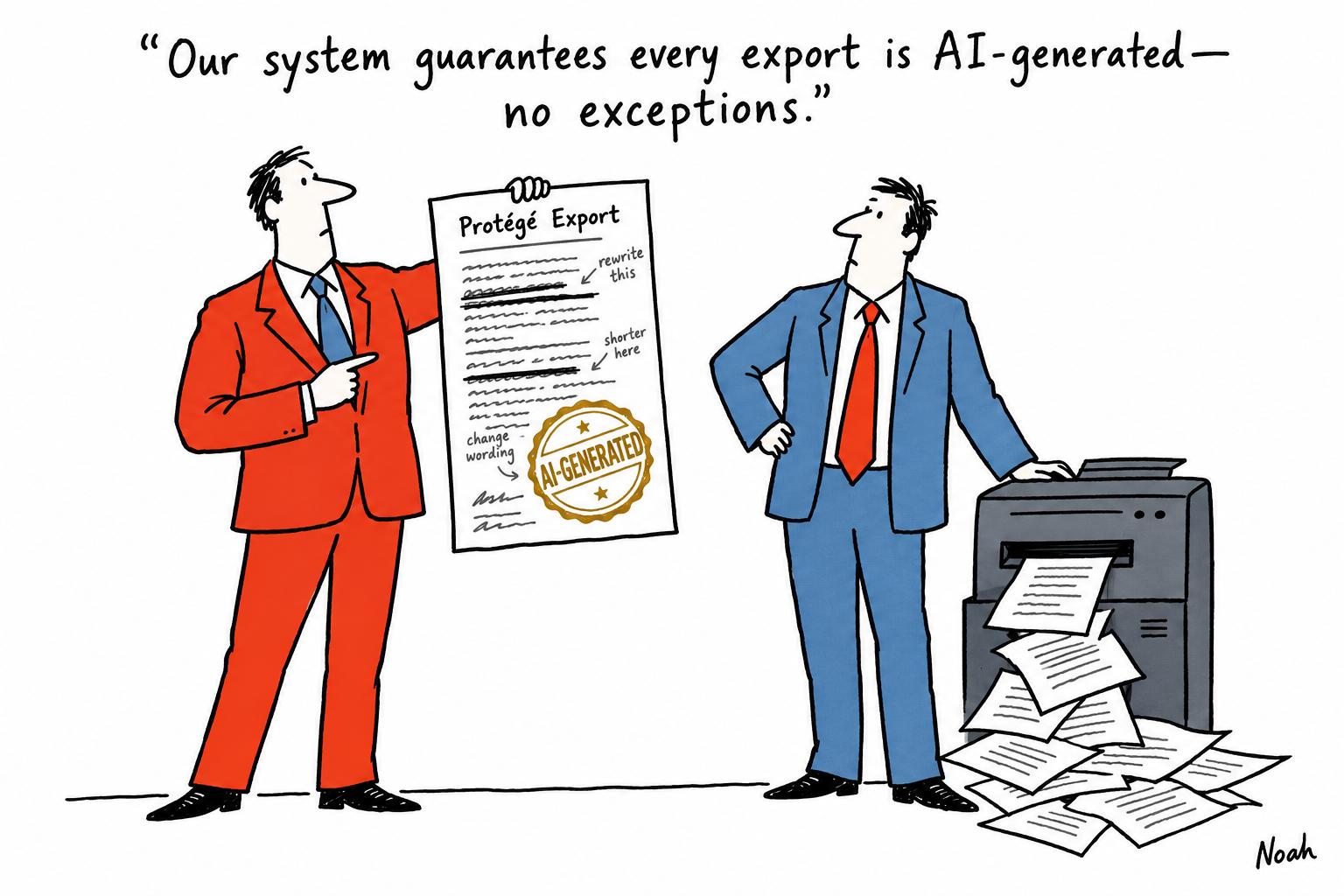
Hidden metadata in Protégé downloads identifies files as AI-generated and unverified, even when users delete the system’s text and write the document themselves.
On 18 October, while testing exports from LexisNexis’s Protégé platform, a legal commentator found something unexpected in the hidden document properties of downloaded files: five metadata fields that appeared to identify the content as AI-generated, name LexisNexis as the provider, flag the material as not yet verified by a human, and reference Article 50 of the European Union’s AI Act. The same labels were present in Word, Excel, PowerPoint and PDF output, even though nothing on the screen warned users that such markings would be attached to their files.
The most striking part of the discovery was that the label did not seem to distinguish between material drafted by the system and material written entirely by a person inside Protégé’s canvas. In one test, the reviewer asked the system to generate a blank memo, deleted the AI-created text and typed the document manually, yet the downloaded file still carried the same AI-generated marking. By contrast, simple copy-and-paste did not preserve the metadata at all, suggesting that the label follows the export function rather than the underlying content itself.
That inconsistency becomes more important when set against other Protégé features. Skills-mode exports also carried the hidden AI properties when the system produced Excel, Word and PowerPoint files, while a separate review-table workflow, despite being heavily driven by AI output, appeared to produce no such stamp. A control test with ordinary Lexis+ case downloads did not show the same AI metadata, which points to the mark being tied specifically to Protégé rather than to the wider platform.
The legal rationale is likely to be found in Article 50 of the EU AI Act. The European Commission’s AI Act service desk says the provision imposes transparency duties on providers and deployers of certain AI systems, including requirements to mark AI-generated content in a machine-readable way. Other explainers of the rule note that the relevant obligations are already in force for some systems, with a later compliance date for older products, and that metadata is one of the methods regulators expect companies to use.
That helps explain why a vendor might choose to embed invisible labels in exported files, but it does not resolve the disclosure problem. The LexBlog account says the firm behind Protégé had not told customers about the feature in its release notes, help pages or launch materials, and that users only discovered it by opening file properties themselves. If a law firm sends a memo or brief built from one of these downloads, the hidden metadata travels with it unless someone strips it out first.
The episode also places LexisNexis in a broader industry conversation about how AI systems should advertise their own involvement. Anthropic recently said Claude would begin digitally watermarking content to comply with the same EU rule, and the company made a point of explaining the change publicly. That contrast matters: one vendor announced its approach and described the mechanism, while the other appears to have been stamping files for weeks before customers noticed. The practical concern for law firms is obvious enough: if AI tools are altering the metadata of work product, firms need to know not just that it is happening, but exactly when, how and to what kinds of documents.
Source Reference Map
Inspired by headline at: [1]
Sources by paragraph:
Source: Noah Wire Services
Noah Fact Check Pro
The draft above was created using the information available at the time the story first
emerged. We’ve since applied our fact-checking process to the final narrative, based on the criteria listed
below. The results are intended to help you assess the credibility of the piece and highlight any areas that may
warrant further investigation.
Freshness check
Score:
8
Notes:
The article was published on 27 October 2026, reporting on a feature in LexisNexis's Protégé platform that embeds AI-generated metadata into downloaded files. The earliest known publication date of similar content is 18 October 2026, indicating the information is relatively fresh. However, the article mentions that this feature has been in place since at least 20 August 2026, suggesting that the feature itself is not new. The article appears to be original, as it provides specific user experiences and tests conducted by the author. There are no indications of the content being recycled from other sources. The article does not appear to be based on a press release, as it includes personal testing and observations. No discrepancies in figures, dates, or quotes were noted. The article does not include updated data but focuses on reporting the feature's existence and implications. Overall, the content is original and timely.
Quotes check
Score:
7
Notes:
The article includes direct quotes from the LexBlog account and a Lexis representative. The earliest known usage of these quotes is within the article itself, suggesting they are original to this piece. However, the article does not provide external verification for these quotes, making them unverifiable. The lack of independent verification raises concerns about the accuracy and authenticity of the quotes. The wording of the quotes appears consistent, with no variations noted. Given the unverifiable nature of the quotes, the score is reduced.
Source reliability
Score:
6
Notes:
The article originates from LexBlog, a niche publication focusing on legal industry news and commentary. While LexBlog is reputable within its niche, it is not a major news organisation, which may limit its reach and influence. The article does not appear to be summarising or aggregating content from other publications, indicating a degree of independence. However, the lack of external verification for quotes and the reliance on a single source for information about LexisNexis's practices raise concerns about the reliability of the content.
Plausibility check
Score:
7
Notes:
The article reports on a feature in LexisNexis's Protégé platform that embeds AI-generated metadata into downloaded files. This claim is plausible, given the increasing integration of AI in legal technology. The article provides specific examples and tests conducted by the author, adding credibility to the claims. However, the lack of external verification for these claims and the absence of corroborating reports from other reputable outlets raise questions about the accuracy and authenticity of the information. The article does not lack specific factual anchors, as it includes dates, specific features, and user experiences. The language and tone are consistent with the topic and region, with no inconsistencies noted. There is no excessive or off-topic detail, and the tone is appropriate for a news report.
Overall assessment
Verdict (FAIL, OPEN, PASS): REVIEW
Confidence (LOW, MEDIUM, HIGH): MEDIUM
Summary:
The article reports on a feature in LexisNexis's Protégé platform that embeds AI-generated metadata into downloaded files. While the content is original and timely, there are concerns regarding the reliability and accuracy of the information. The quotes included in the article are unverifiable, and the source relies on a single, non-independent publication. The lack of external verification and corroborating reports from other reputable outlets raises questions about the authenticity of the claims. Therefore, a thorough review and additional verification are recommended before publishing.