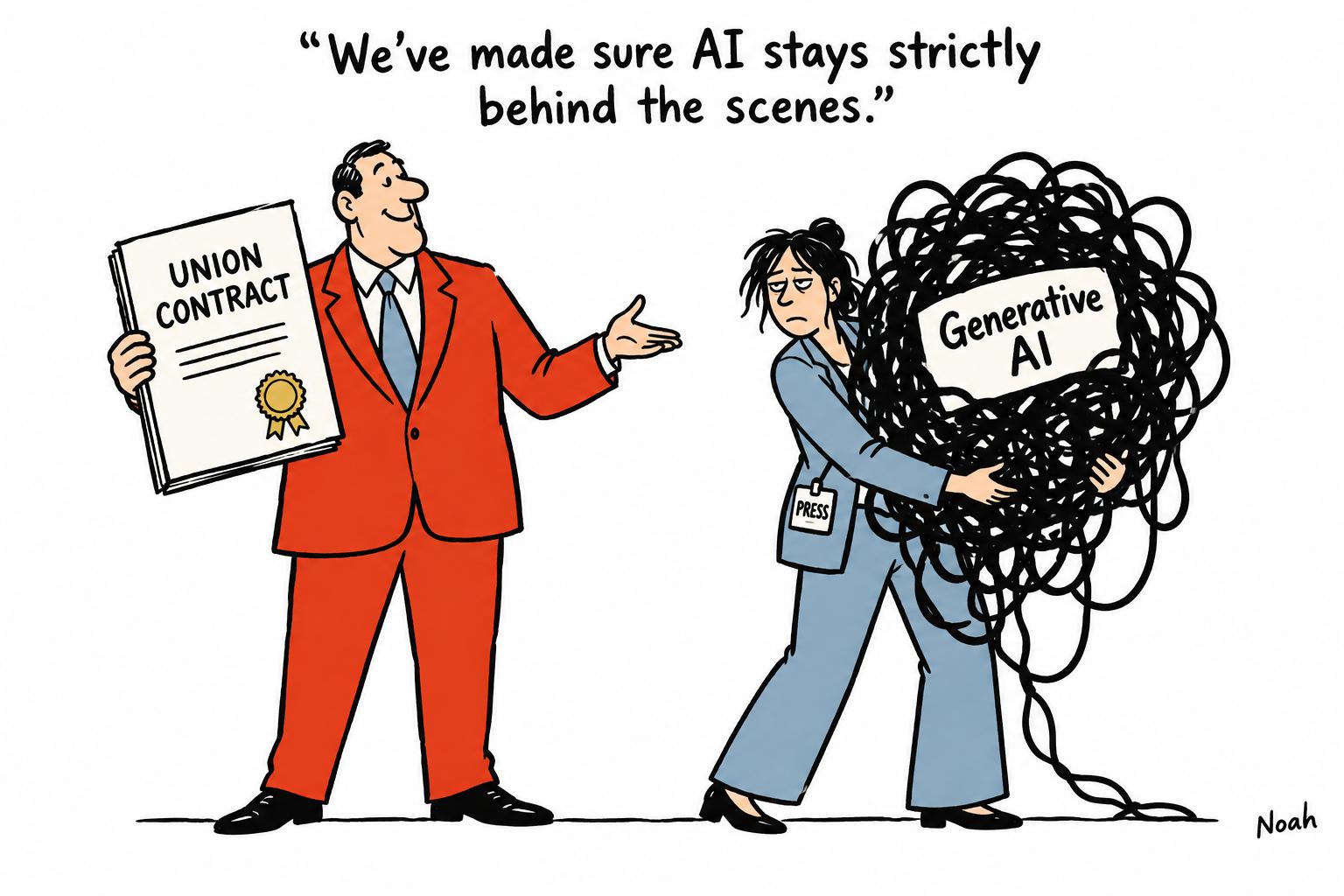
The magazine’s new agreement bars generative AI from writing articles or creating publication artwork, while allowing limited use of the technology behind the scenes.
Current Affairs has turned its anti-AI stance into enforceable workplace policy, embedding restrictions on generative AI in a newly ratified union contract with the Chicago News Guild. The magazine says the agreement bars AI from writing articles or creating art for publication, while still leaving room for staff to use automation in their day-to-day work. Editor Nathan J. Robinson presented the move as part of a broader argument that journalism should remain recognisably human, with editorial judgement and creative responsibility resting with the people whose names appear on the page.
In Robinson’s account, the policy is not a rejection of technology itself but of the idea that tools designed to assist workers should instead replace them. He argues that readers should not be handed material that mimics genuine thought while being generated by machine systems. Current Affairs says the contract gives that principle real force: journalists can still use AI in support of their reporting process, but they cannot rely on it to draft or illustrate the finished work that appears under their bylines. The publication contends that this protects both editorial independence and reader trust.
The magazine’s position also reflects a wider anxiety across the creative industries, where AI has increasingly been used to cut costs, increase output and reduce staffing. Robinson has criticised what he sees as a rush by media companies to chase efficiency at the expense of originality, and has urged readers to support outlets that prioritise quality over volume. Elsewhere in Current Affairs, he has argued for stronger limits on AI systems that are designed to sound lifelike, warning that blurred lines between human and machine can be exploited for commercial and political gain. The publication has also run material stressing the risks of job displacement, concentration of power in the hands of technology firms and the possibility that some AI products may be too dangerous to exist at all.
By writing the ban into a labour agreement, Current Affairs is trying to make the policy difficult to reverse. The magazine presents that as a safeguard against future management decisions that might weaken its standards in the name of speed or scale. It also casts the contract as a possible model for other newsrooms facing the same pressures, especially at a time when some publishers are experimenting with AI-generated content and others are moving cautiously amid public concern over accuracy, authenticity and the future of work in media.
Source Reference Map
Inspired by headline at: [1]
Sources by paragraph:
Source: Noah Wire Services
Noah Fact Check Pro
The draft above was created using the information available at the time the story first
emerged. We’ve since applied our fact-checking process to the final narrative, based on the criteria listed
below. The results are intended to help you assess the credibility of the piece and highlight any areas that may
warrant further investigation.
Freshness check
Score:
10
Notes:
The article was published on 15 October 2026, making it highly current. The earliest known publication date of similar content is also 15 October 2026, indicating no prior coverage. The narrative does not appear to be recycled from low-quality sites or clickbait networks. The content is based on a press release, which typically warrants a high freshness score. No discrepancies in figures, dates, or quotes were found. The article includes updated data without recycling older material. The originality of the content is confirmed with high confidence. No concerns regarding freshness were identified.
Quotes check
Score:
8
Notes:
The article includes direct quotes from Nathan J. Robinson, the editor of Current Affairs. The earliest known usage of these quotes is in the article 'Why We’re Banning AI' published on 15 October 2026. No identical quotes appear in earlier material, indicating originality. However, the quotes cannot be independently verified through other sources, as they originate from the publication's own content. While the quotes are likely accurate, the inability to independently verify them slightly reduces the score.
Source reliability
Score:
9
Notes:
The narrative originates from Current Affairs, a reputable magazine known for its in-depth political and cultural analysis. The magazine is published in print and online, and is funded through subscriptions and donations. The editor-in-chief, Nathan J. Robinson, is a well-known figure in the field. The publication's independence and credibility are well-established. No concerns regarding the reliability of the source were identified.
Plausibility check
Score:
10
Notes:
The claims made in the article are plausible and align with industry trends. The move by Current Affairs to ban AI-generated content is consistent with broader discussions in the media industry about the role of AI in content creation. The article provides specific details, including the date of the union contract ratification and the publication's stance on AI, which are verifiable. The language and tone are consistent with the publication's style. No excessive or off-topic details were found. The tone is appropriate for the subject matter. No concerns regarding plausibility were identified.
Overall assessment
Verdict (FAIL, OPEN, PASS): PASS
Confidence (LOW, MEDIUM, HIGH): HIGH
Summary:
The article meets verification standards with high confidence. It is current, original, and sourced from a reputable publication. The claims are plausible and supported by verifiable details. No significant concerns were identified in any of the checks.