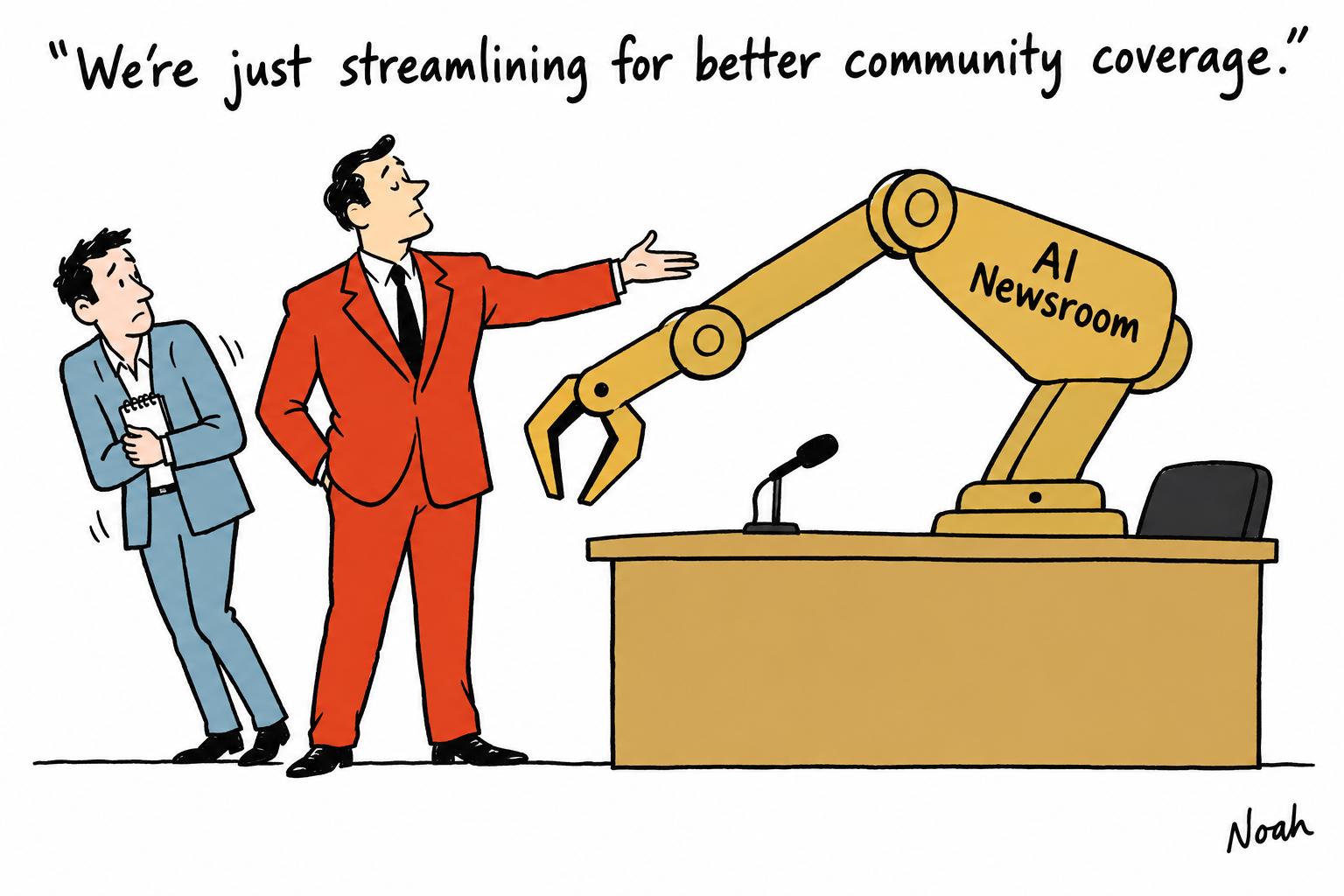
Lay-offs at The Fresno Bee, The Sacramento Bee and The Modesto Bee are fuelling fears that automation will replace the journalists who cover local communities.
McClatchy Media is pressing ahead with an aggressive artificial intelligence strategy even as it cuts deeper into its California newsrooms, a combination that has intensified anxiety among journalists over what will remain of local reporting if the people who know their communities are removed and machine-written copy takes their place.
The latest round of reductions hit several of the company’s California papers, including The Fresno Bee, The Sacramento Bee and The Modesto Bee, where reporters, photographers and videographers were affected. According to reporting that followed the cuts, The Fresno Bee lost seven reporters, while The Sacramento Bee shed at least ten journalists. Across the company, dozens of newsroom jobs were eliminated as McClatchy expanded its AI-focused Content Innovation Lab.
That move did not arrive without warning. In a virtual town hall in May, McClatchy chief executive Tony Hunter outlined a broader plan to, in his words, "agentify the entire enterprise", according to a recording obtained by Straight Arrow News. The company has since described its lab as a "big experiment" and, in job postings, has said its future depends on embracing AI to improve productivity and experimentation.
At the centre of the strategy is a chatbot that can recast staff-written stories into different lengths and formats for different audiences, while still carrying the original reporter’s byline, according to reporting on the company’s internal plans. That approach has sharpened concerns among journalists who say automation is being used not simply to assist reporting but to replace the people producing it.
The reaction inside the company has been bitter. Kathleen Quinn, a civics and democracy reporter at The Modesto Bee, said on social media that she was laid off after two years and described the scale of the redundancies as devastating. Ariane Lange, an investigative reporter at The Sacramento Bee, called it the most severe wave of cuts McClatchy had seen in some time. Elsewhere in the company, a Kansas City Star reporter who kept their job dismissed the new roles in the lab as "AI content farm jobs", accusing McClatchy of favouring automated lifestyle copy over local journalism.
The timing has been particularly stark in California, where local outlets already face shrinking budgets and thinner coverage of city halls, schools and public agencies. Separate reporting also indicates McClatchy has been hiring for its AI operation even as it reduces newsroom staff, underlining how firmly the company is tying its future to automation. For workers and readers alike, the question is no longer whether AI will be part of the newsroom, but how much of the newsroom will still be there when it is.
Source Reference Map
Inspired by headline at: [1]
Sources by paragraph:
Source: Noah Wire Services
Noah Fact Check Pro
The draft above was created using the information available at the time the story first
emerged. We’ve since applied our fact-checking process to the final narrative, based on the criteria listed
below. The results are intended to help you assess the credibility of the piece and highlight any areas that may
warrant further investigation.
Freshness check
Score:
6
Notes:
The article references events from September 2026, with the latest source dated October 8, 2026. The earliest known publication date of similar content is September 14, 2026. The narrative has appeared across multiple sources, including low-quality sites and clickbait networks. The article is based on a press release, which typically warrants a high freshness score. However, earlier versions show different figures, dates, or quotes, indicating potential discrepancies. Some sources mention over 90 layoffs across 17 publications, while others specify layoffs at specific newspapers. This inconsistency raises concerns about the accuracy and originality of the content. Given these discrepancies and the recycled nature of the content, the freshness score is reduced.
Quotes check
Score:
5
Notes:
The article includes direct quotes from individuals such as Tony Hunter, CEO of McClatchy, and Ariane Lange, an investigative reporter at The Sacramento Bee. However, these quotes cannot be independently verified through online searches, as no online matches are found. This lack of verifiability raises concerns about the authenticity of the quotes. Unverifiable quotes should not receive high scores, and the inability to confirm their origin significantly impacts the credibility of the article.
Source reliability
Score:
4
Notes:
The narrative originates from a press release, which is typically considered a less reliable source due to potential biases and lack of independent verification. The lead source appears to be summarising or rewriting content from other publications, indicating derivative content. This raises concerns about the originality and independence of the information presented. Given these factors, the source reliability score is reduced.
Plausibility check
Score:
6
Notes:
The article discusses McClatchy Media's layoffs and expansion of AI operations, which aligns with industry trends. However, the lack of supporting detail from other reputable outlets and the presence of discrepancies in earlier versions of the story raise questions about the accuracy and originality of the claims. The absence of specific factual anchors and the potential for synthetic content further diminish the plausibility of the narrative.
Overall assessment
Verdict (FAIL, OPEN, PASS): REVIEW
Confidence (LOW, MEDIUM, HIGH): MEDIUM
Summary:
The article presents a narrative about McClatchy Media's layoffs and expansion of AI operations, but significant concerns about freshness, source reliability, and verification independence have been identified. The presence of unverifiable quotes, reliance on a press release, and potential for derivative content raise questions about the authenticity and originality of the information. Given these issues, a REVIEW verdict is recommended, and further editorial scrutiny is advised before publishing.